Calculator.net gets 11M visits a month from Google, and it does it with small free tools that give the answer the moment a page loads.
It has just 222 pages. That's about 50K visits for every one of them.
Most sites chase traffic by publishing more. This one did the opposite, and it works better than almost anything we've measured.
Here are 8 lessons you can copy from it, plus the one thing you can't.
Count visits per page, not pages
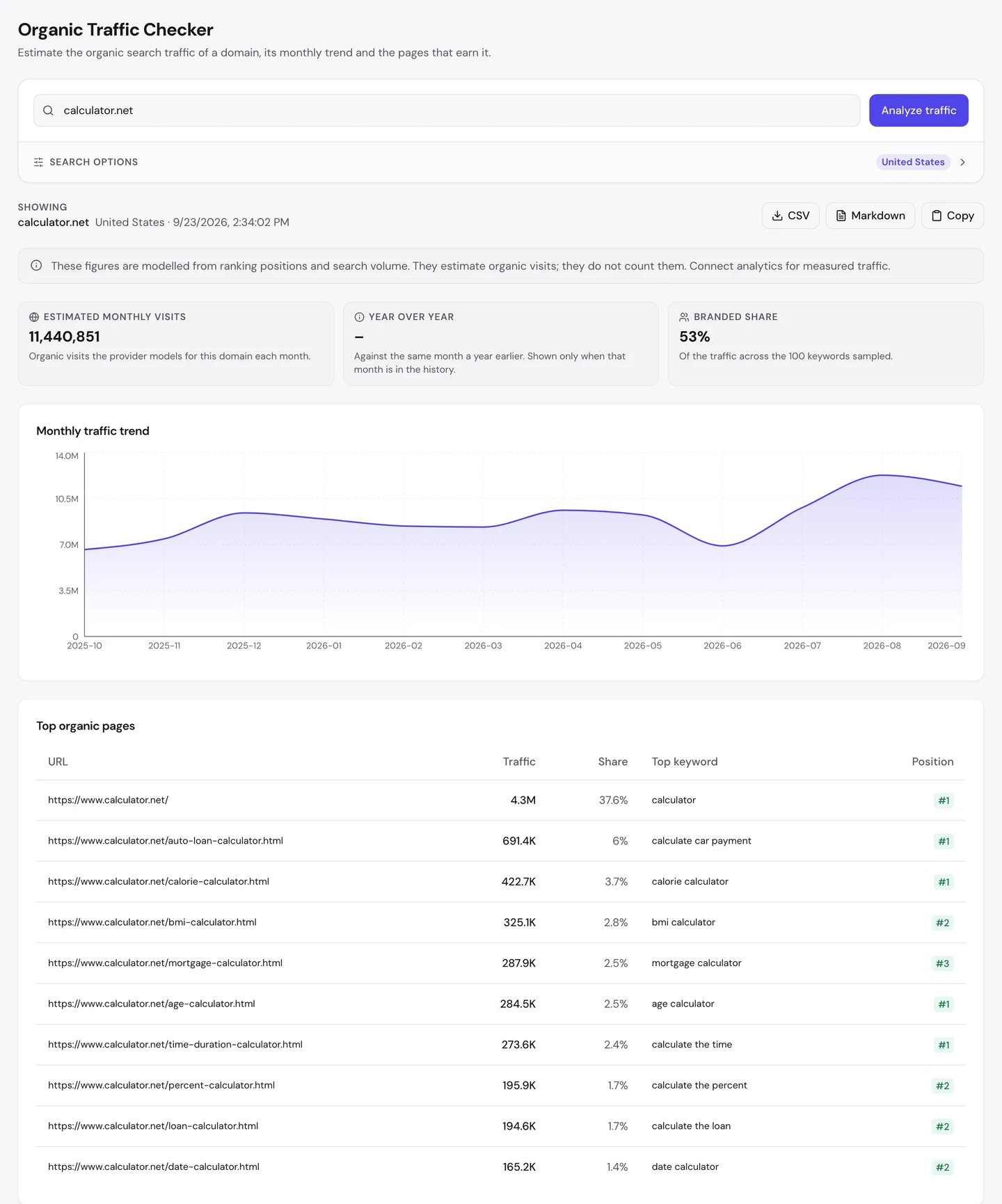
We ran calculator.net through our Organic Traffic Checker. It estimates a site's organic traffic, meaning the people who find it on Google without ads.
The answer was about 11M.
That counts the US only. The Traffic tab of our Website Audit puts calculator.net at about 25M search visits a month worldwide, with India close behind the US.
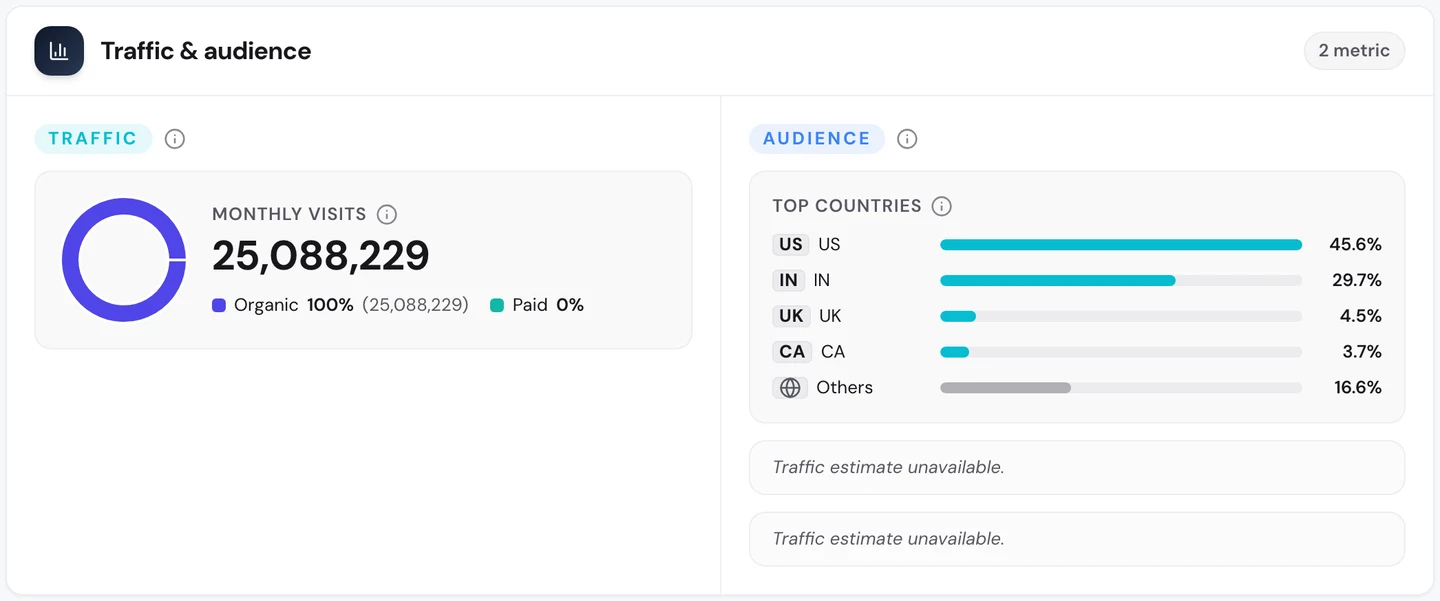
Then we counted its pages. Most sites list their pages in a sitemap, a file that tells Google what's there.
This site's sitemap lists 222 pages. Nearly 200 of them are tools.
Now look at its biggest rival. Omni Calculator lists nearly 9K pages in its sitemap, about 40 times more.
We ran Omni through the same Organic Traffic Checker. It gets about 4.6M visits a month from Google.
So the site with 40 times fewer pages gets more than twice the visits.
So page count tells you almost nothing. The number that matters is visits per page.
You can work out your own in a minute. Take your monthly visits from Google and divide by the number of pages you publish.
If the answer is small, more pages won't fix it. You need pages people are actually looking for.
Find the sums people do by hand
It all started with search data, not a hunch.
The founder, Huiming Gu, was an engineer in Houston. In 2008, he looked at Google Trends and Google's keyword planner to see what people searched for.
He saw huge demand for sums and conversions, and hardly any good sites that did them. So he built one.
Google's own story about the site says it's still run by him and just 2 staff.
So what are people looking for on the site today?
The top 5 pages are the homepage and 4 tools: auto loan, calorie, BMI and mortgage.
There are no articles and no blog posts. Every page does one sum.
Searches like "mortgage calculator" are gold for 3 reasons. People type them every single day, it's obvious what they want, and the best answer is a box you type into, not a page of text.
Nobody wants to read about BMI. They want their number.
Your own field has sums like these. Here's how to find them.
- List the questions customers ask you that end in a number. "How much will it cost?" "How long will it take?" "How many do I need?"
- Look at the spreadsheets your team rebuilds every month. Each one is a calculator waiting to happen.
- Check how many people search each one with our Keyword Research tool.
- Build the one with the most searches first.
Not sure where to start? Try these search patterns with your own words in the gaps: "[your product] cost calculator", "[this] to [that] converter" and "how many [things] do I need".
Any keyword tool can also list every "calculator" search in your field at once. That helps you spot the ones nobody has built well yet.
The best ideas look boring in a keyword list. That's exactly why they're often still open.
Your rivals can show you more. The audit's Competitors tab lists the sites that rank for the same searches, and the words they win that you don't.
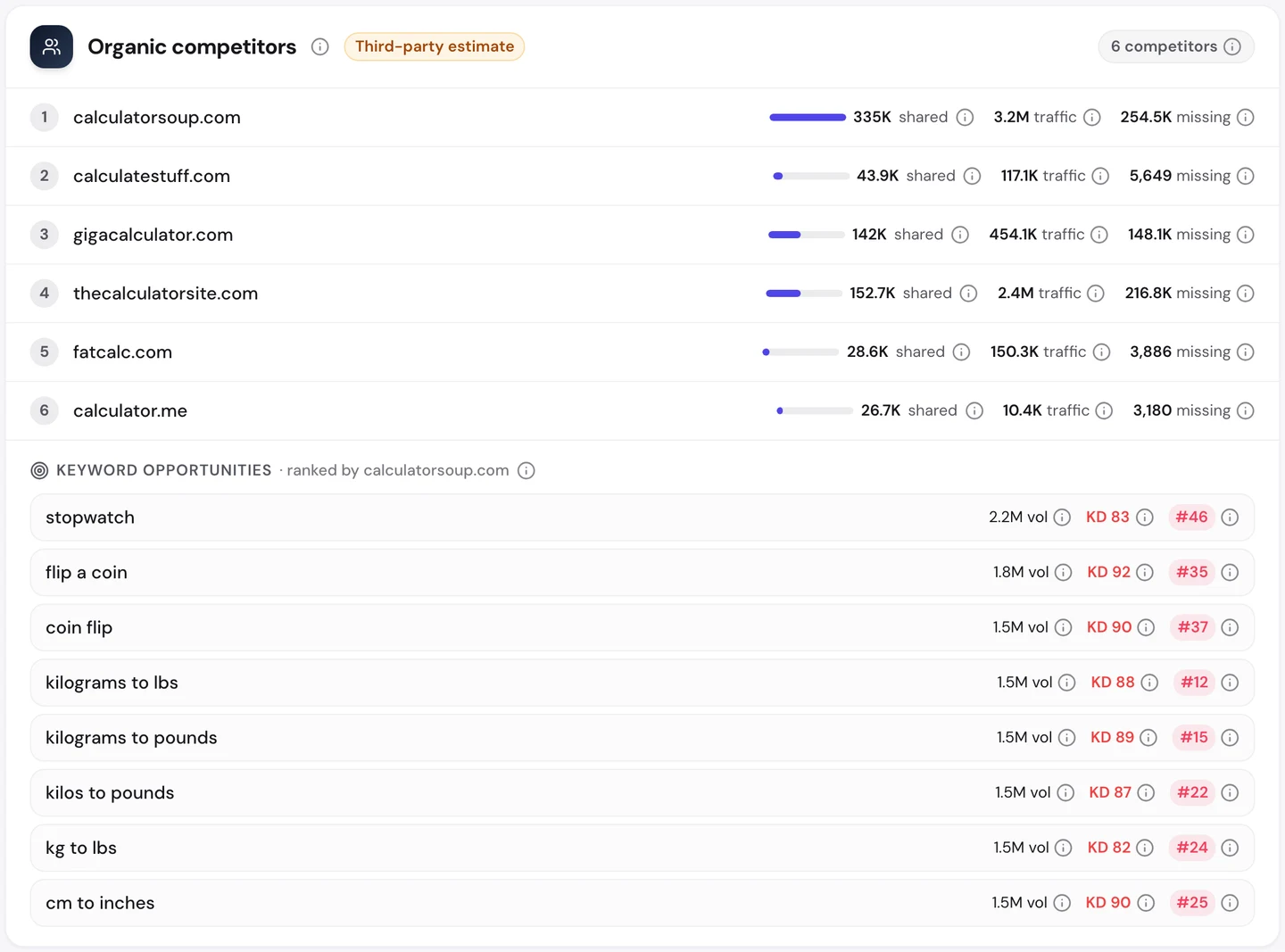
Even calculator.net has gaps like that, and so will you. Each one is a sum people do by hand, waiting for your better page.
Put the answer at the top
Here's where most sites go wrong.
Ask for advice on "mortgage calculator" and you'll often hear: write a long guide, then put the tool halfway down.
This site does the reverse.
The tool comes first. The how-to sits below it for anyone who wants it.
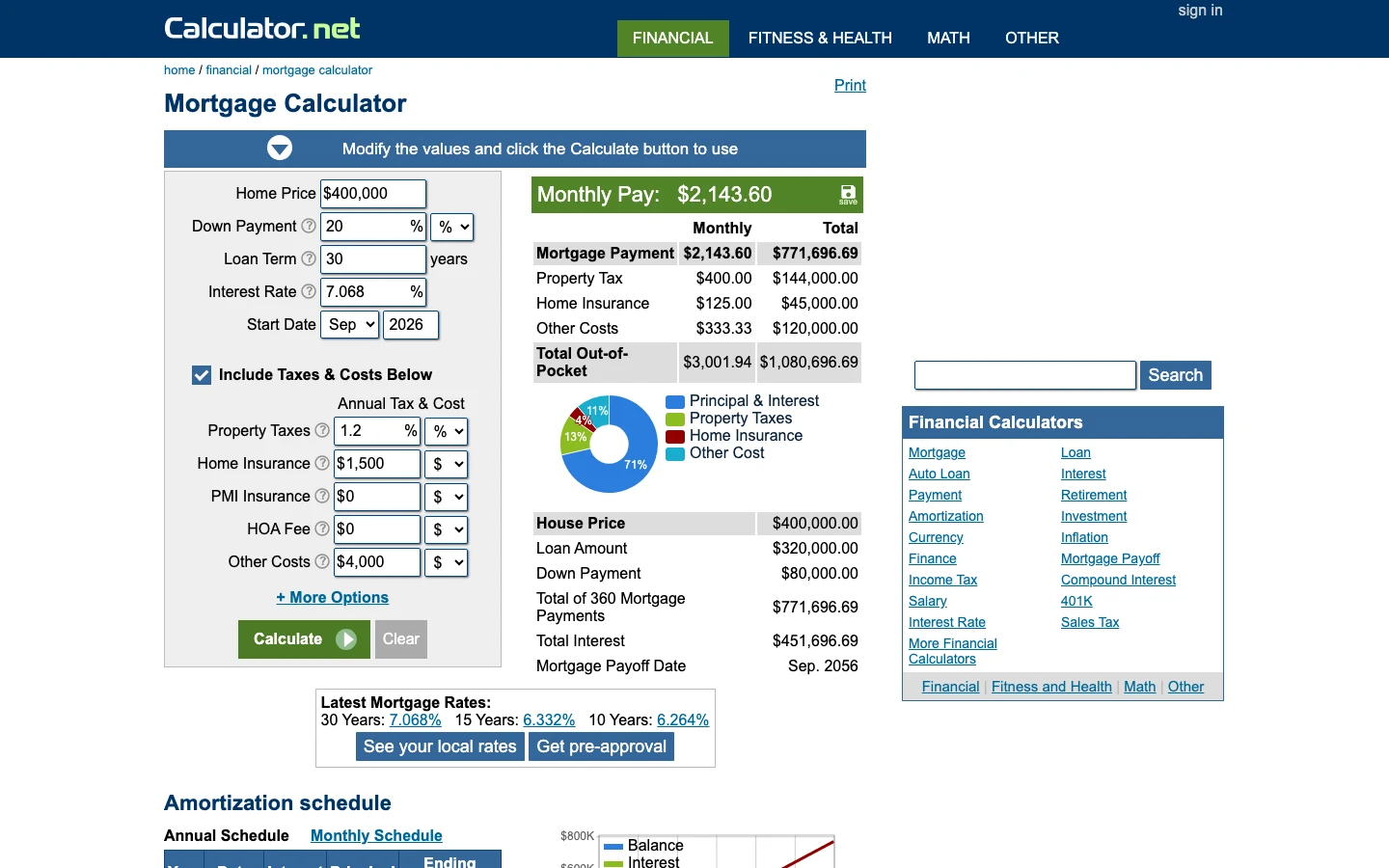
That order is the whole trick. A page that answers right away gives the searcher what they came for.
A page that makes them scroll past an intro often sends them back to Google. You never even find out they left.
Now look at the right side of that screenshot. There's a box with links to about 20 other money tools.
Someone who just worked out a home loan often wants their car loan or tax next.
Do those links do their job? The audit's Technical SEO tab shows how they hold the site together.
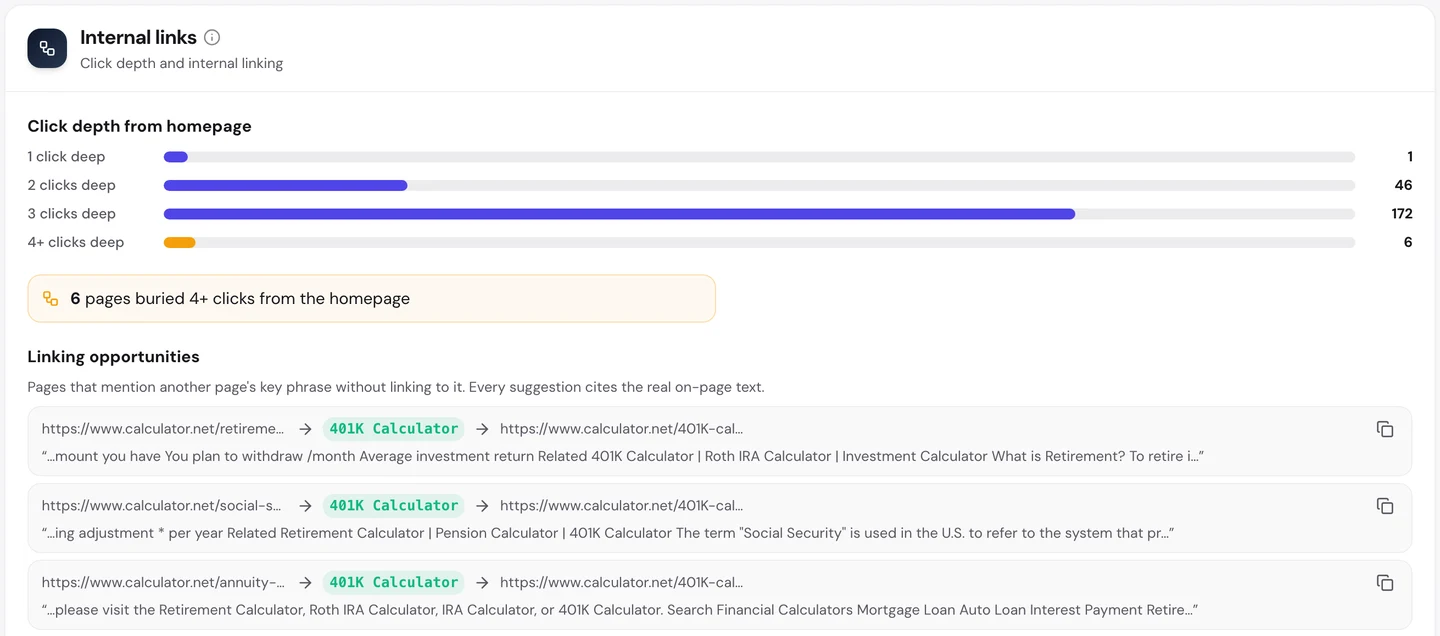
Almost every page sits 2 or 3 clicks from the homepage, so Google can reach them all. The audit even lists spots where a page names another tool but doesn't link to it.
Run it on your own site, and you'll see which of your pages you've left buried.
So link each tool to the ones people need next. It keeps them on your site, and it helps Google find every page.
GeeksforGeeks, a big coding help site we also looked at, found the same thing by luck. 4 of its top 10 pages are unit converters, not tutorials.
Calculator.net gets 11M visits a month from 222 small tools. Building one good tool takes about a week. Knowing which one your buyers search for is the hard part, and that's where we start.
- We find the tool your buyers already search for
- We design, build and host it on your domain
- We put the answer at the top, so it ranks
- A fixed price, agreed before we start
Build light pages that pass audits
A plain site has one more perk: there's less to break. We checked that with our Website Audit.
It crawls a site the way Google does. It opens each page, follows the links to the next ones, and tests every page for problems that can hold it back in search.
We set it to crawl the whole of calculator.net. It checked every page it could find, 225 in all, in about 10 minutes.
The site scored 93 out of 100.
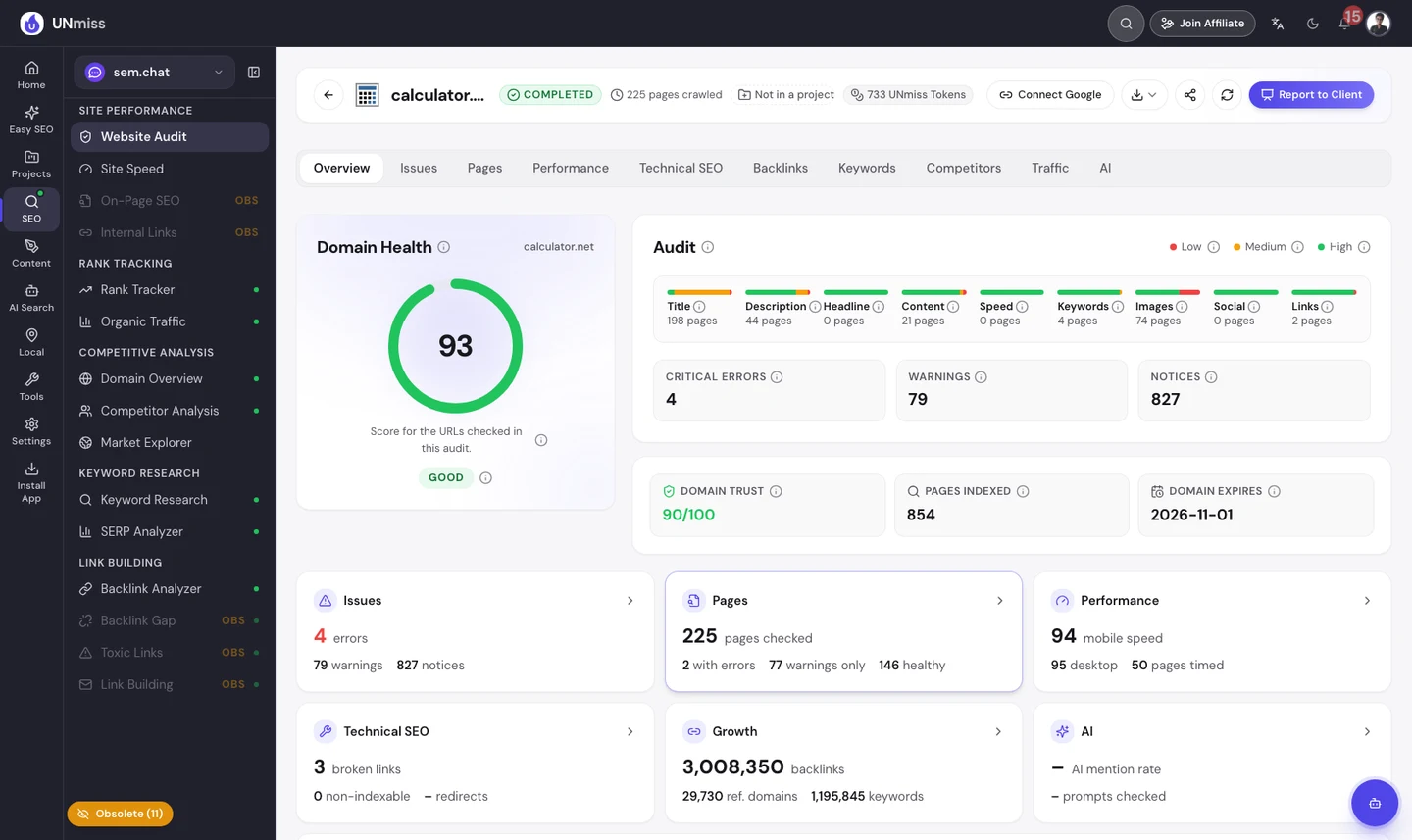
93 sits in the "good" band. Every one of the 225 pages loads fine and can be indexed, which means Google is allowed to store it and show it in results.
Light pages are fast pages, and the Performance tab proves it with real visitors. Core Web Vitals are Google's 3 checks of how fast a page loads, how fast it reacts and whether it stays still, measured on real people's devices.
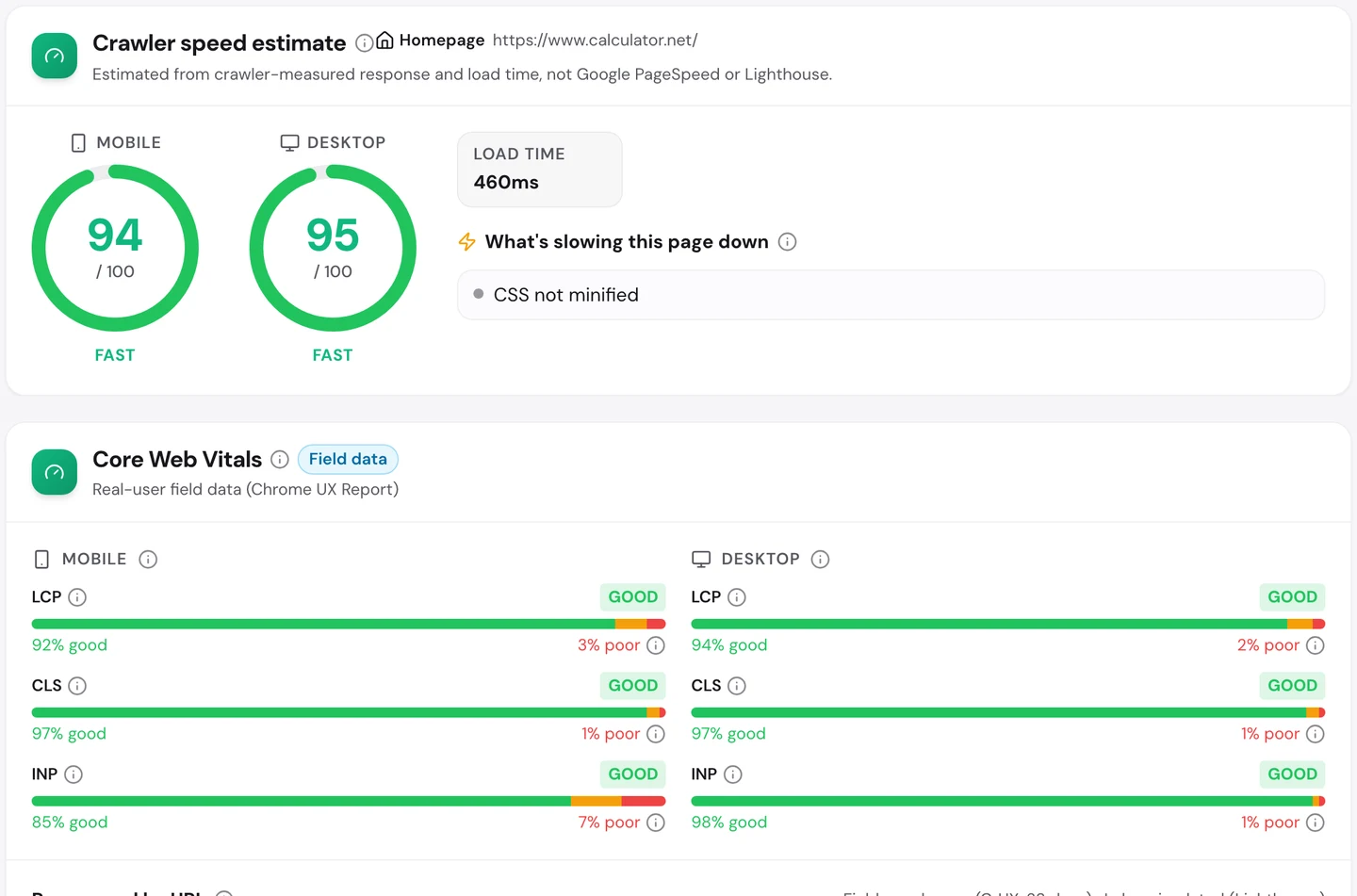
Calculator.net passes all 3, on phones as well as desktops. Keep your own pages this light, and you'll pass too.
The report then sorts every problem by how much it matters, so you always know what to fix first.
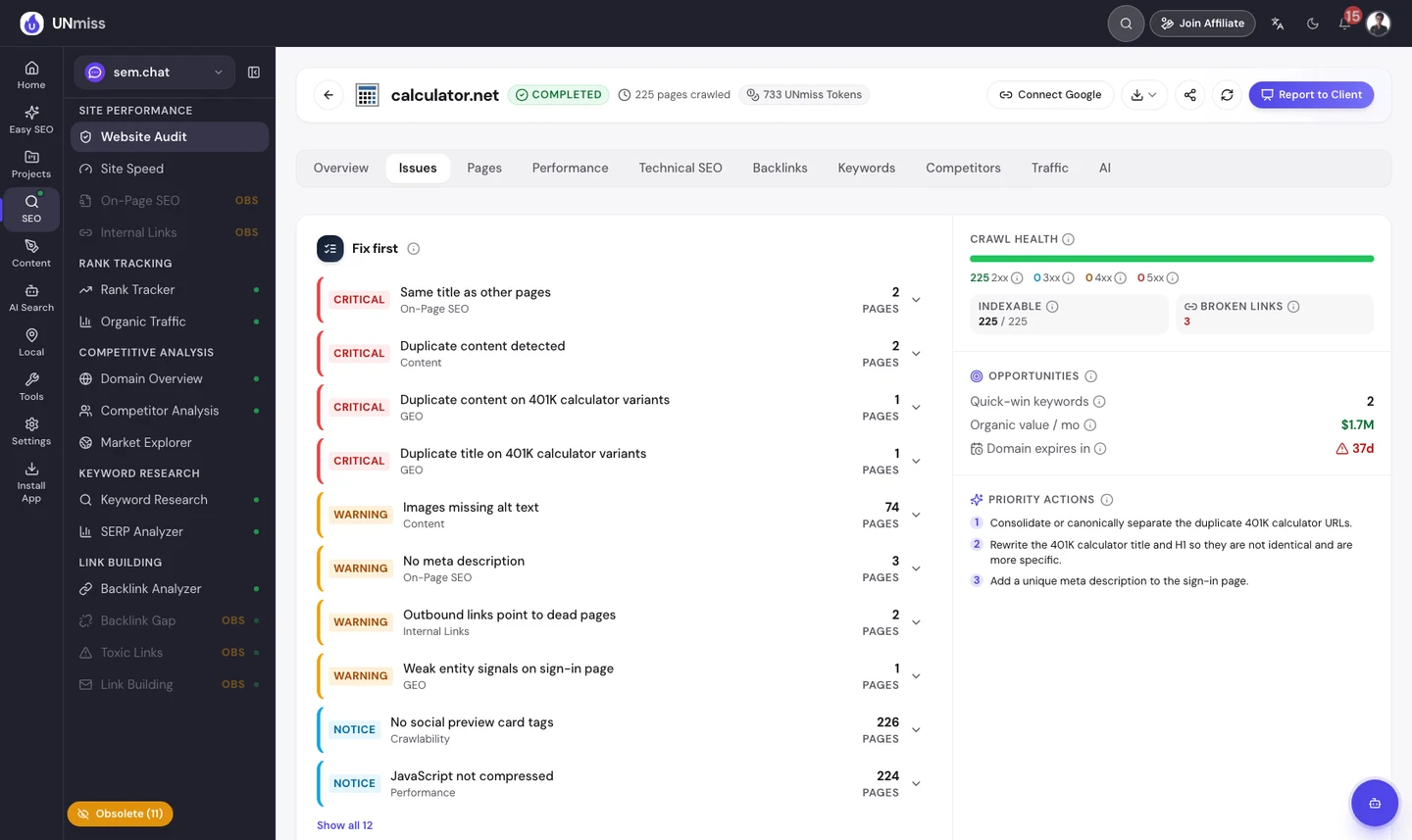
Here's what it found. All 4 critical errors come from one place: 2 versions of the 401K calculator with the same title and content.
The 2 addresses differ by a single letter. One says 401K, the other 401k, and to Google those are 2 different pages.
Google can't tell which one to show, so they compete. The audit's first fix is to merge them, or add a canonical tag, a line of code that tells Google which page is the original.
The warnings are smaller. 74 pages have images with no alt text, the short label that tells Google what a picture shows.
The rest are notices, like titles that repeat the page heading word for word. Worth tidying one day, but not urgent.
The audit's AI tab then turns all of it into a 90-day plan, with the reason for each fix and the steps to make it.
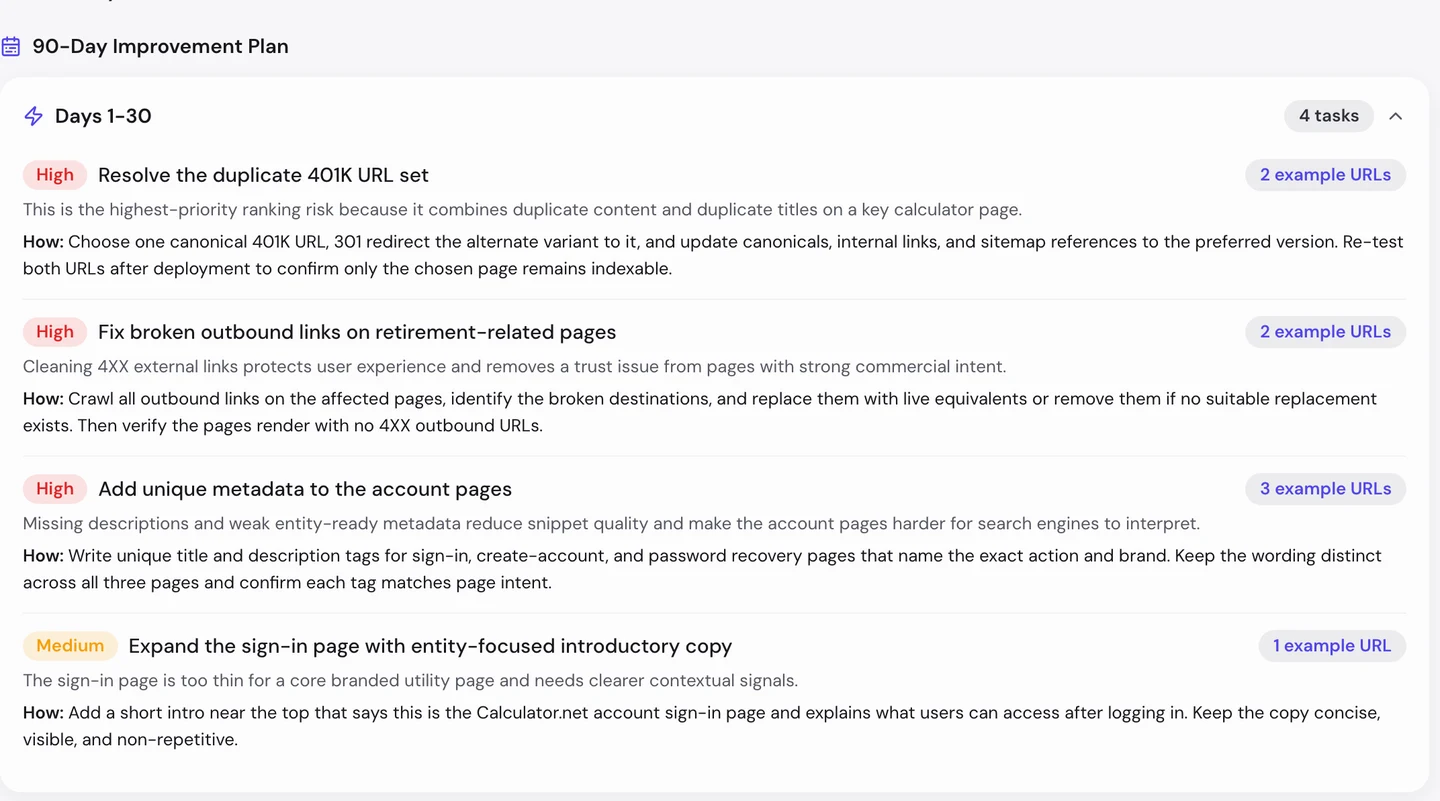
That's a clean result for a site this size, and it comes from how little each page carries. There are no heavy scripts and no big galleries, just a form and an answer.
Want the same kind of check on one page while you browse? Our browser extension runs 35 SEO checks on any page in one click.
Open a calculator page, yours or a rival's, and click the icon. You get a score out of 100 and the exact fix for every problem, right beside the page.
Install it once, and it's ready on every site you visit.
Give your tool away, with credit
A great tool gets visitors. Calculator.net also used its tools to earn links.
A backlink is a link from another website to yours. Google treats each one a bit like a vote of trust.
It lets any site copy its tools for free. There are 5 to pick from, like mortgage and math, plus 4 free WordPress add-ons.
The catch is one small line at the bottom: "powered by calculator.net", with a link back.
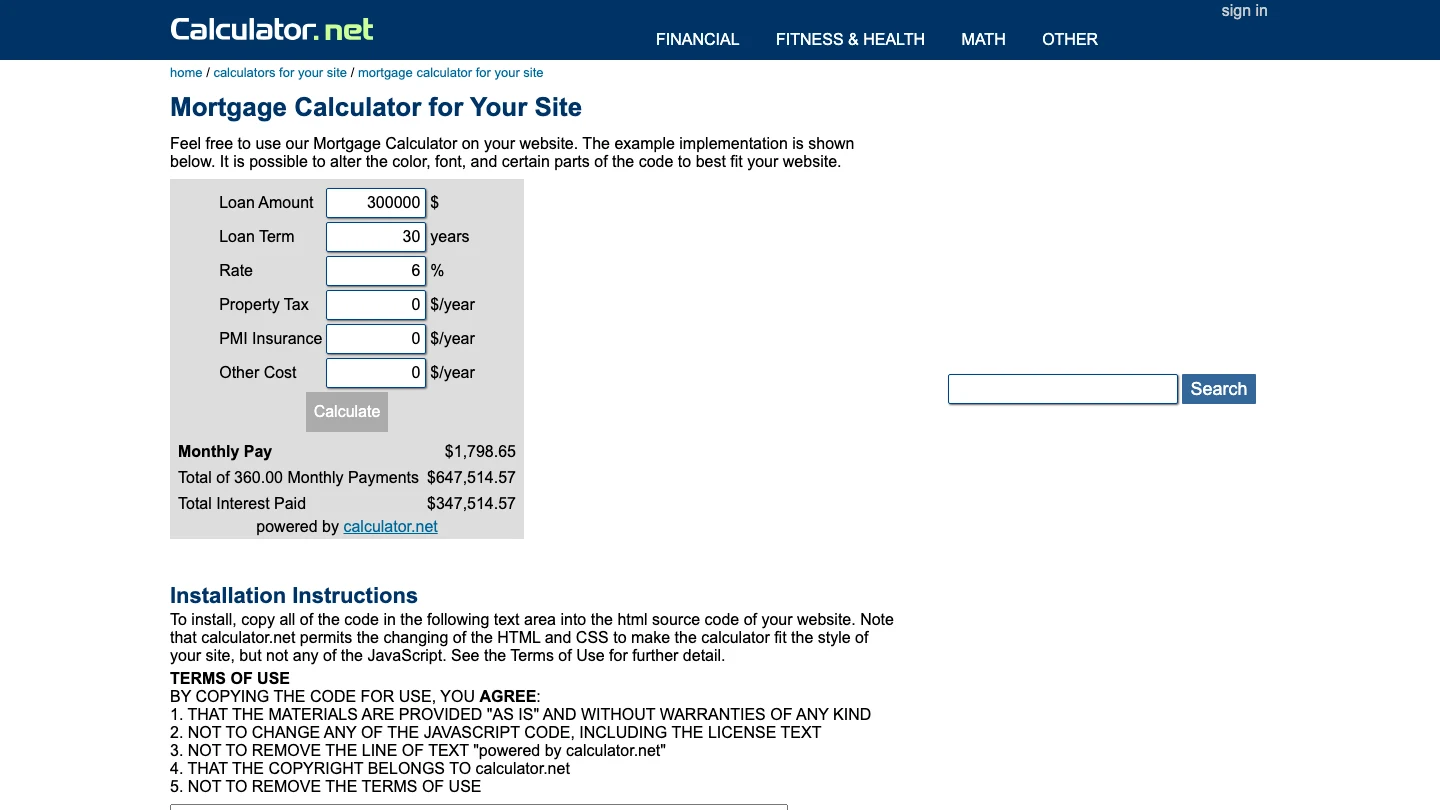
Every site that adds one also adds a link back. Nobody had to send a single email asking for it.
You can do the same. Offer your best tool as a free widget, a small box other sites paste into their pages.
Keep the credit link short and use your brand name in it. We'll see why that matters next.
Check which phrase holds your links
Our Backlink Analyzer found about 3M links pointing at the site, from 31K different websites.
That's about 100 links from each site. When one site links to you 100 times, the link usually sits in a sidebar or footer that repeats on every page.
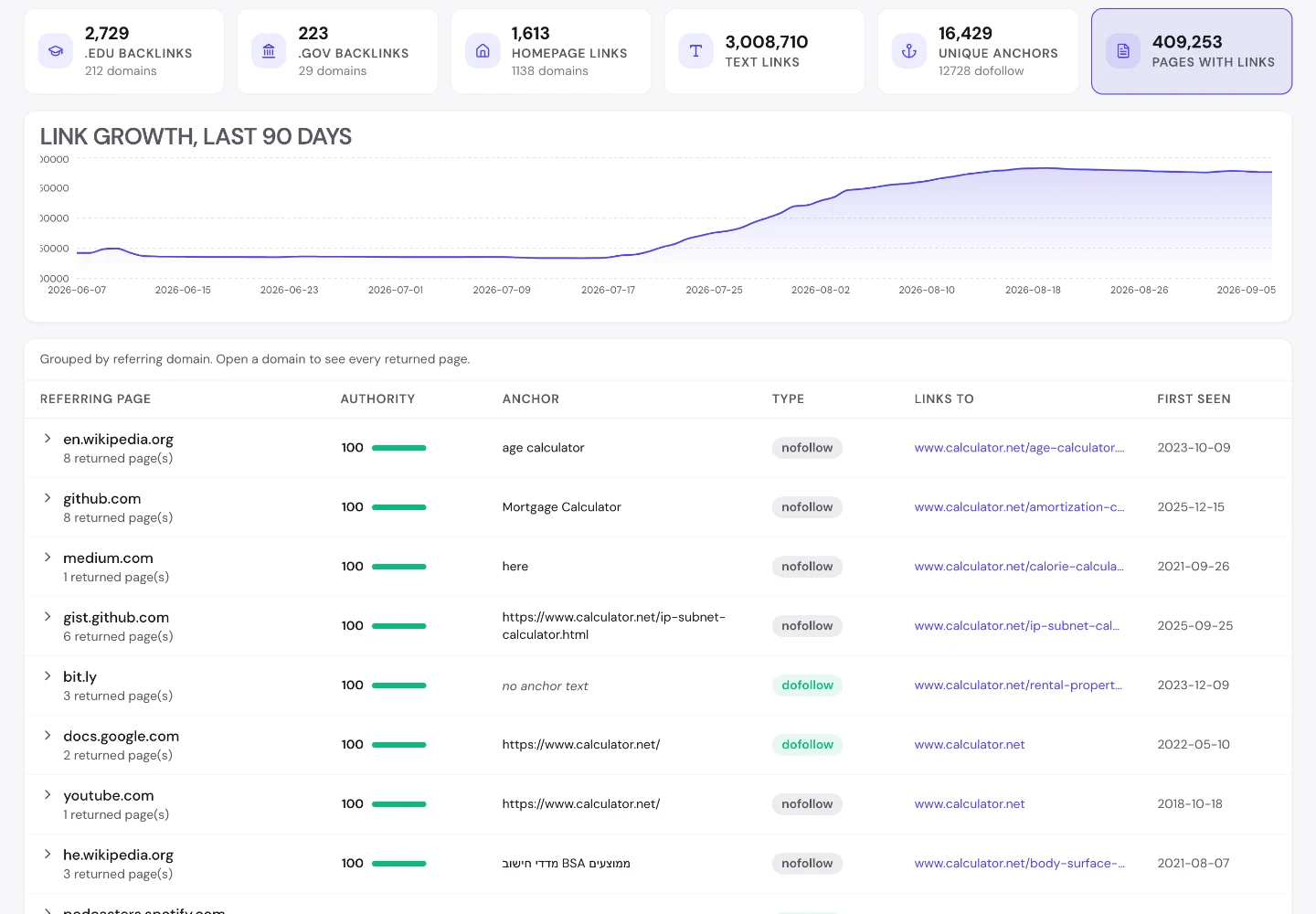
Next, look at the anchor text. It's the clickable words on a link.
Here, the phrase "advanced calculator" carries 74% of all links. The brand name carries under 4%.
That's extreme. RTINGS, the product testing site we also looked at, has its top phrase at just 3%.
94% of its links are also dofollow, which means they pass Google trust.
That fits too. People rarely switch that off on a link they pasted into their own template.
Here's the risk. When one phrase holds most of your links, a few big sites can change a template and take them away overnight.
So check your own top phrase. If one carries most of your links, find out where it comes from before it disappears.
Don't overrate your brand traffic
Links aren't the only place where one thing carries too much.
The homepage alone brings in 38% of all visits. It ranks first on Google for the single word "calculator".
The audit's Keywords tab shows how far that goes. The site ranks first for "calculator", and for typos like "calculato" and "calulator" too.
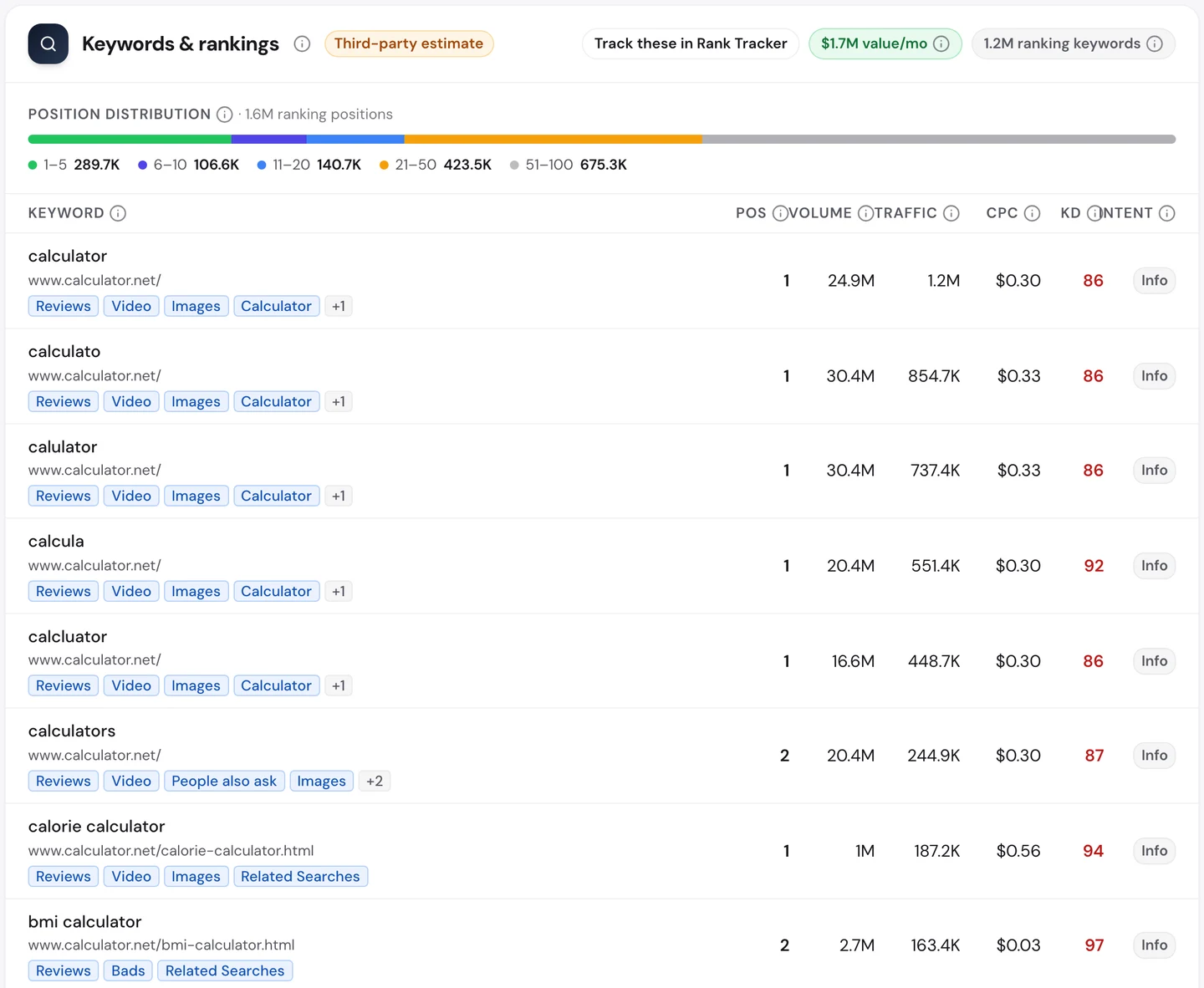
That's a lot of eggs in one basket. If that one ranking slipped, more than a third of the traffic would go with it.
The traffic checker also says 53% of visitors search for the brand. That sounds like loyal fans, but look closer.
The site's name is the thing people search for. When someone types "calculator", the tool can't tell if they meant the brand or just any calculator.
So if your domain is a plain word like this, take your branded share with a pinch of salt.
A rival can win a plain word away from you. They can't take a real brand name.
Build pages that never go stale
Here's the part most sites never get.
Our Domain Overview shows the site ranking for about 1.2M keywords. A keyword is just a phrase people type into Google.
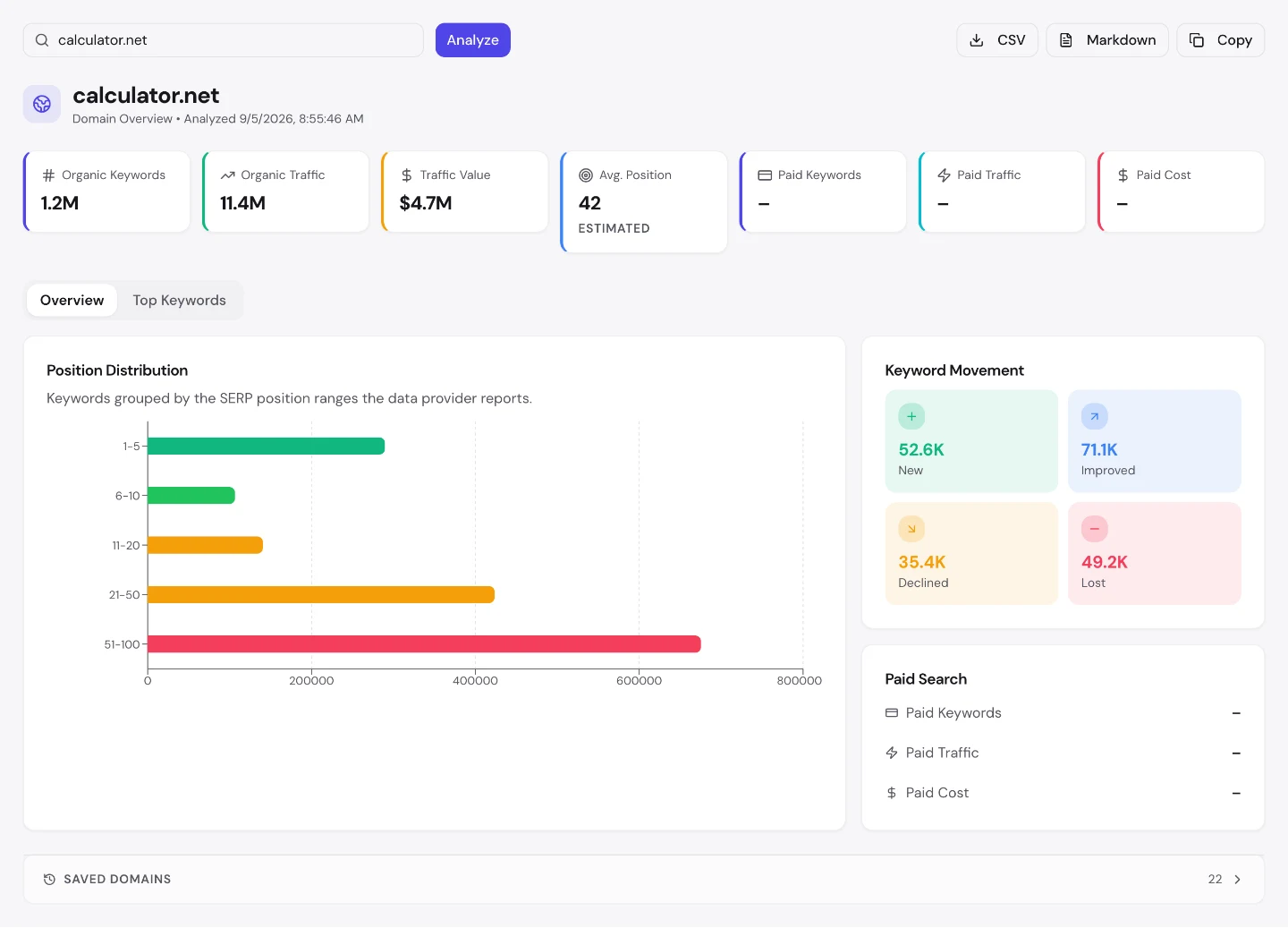
It values that traffic at about $4.7M a month. That's what the same visits would cost as Google ads.
And the rankings are rising. About twice as many keywords moved up as moved down.
The reason is simple. A calculator doesn't go out of date.
People will search "mortgage calculator" just as much in 10 years. The maths won't change, so nobody has to rewrite the page.
Compare that with a news story or a "best of 2026" list. Those need updating every year, and every new one adds to next year's work.
So ask one question before you build a page. Will it still be right in 5 years?
If it will, it's an asset. If it won't, it's a bill you'll keep paying.
Calculator.net gets about 50K visits per page. Our Organic Traffic Checker shows the top pages for any site, so you can see which of yours pull their weight.
- The same report that found 11M visits on 222 pages
- Visits, top keyword and Google position for every page
- Run it on any rival's domain too
What you cannot copy
First, the part you can't copy: the word "calculator".
Calculator.net started in 2008, when few good sites like it existed. Its homepage now ranks first for that one word, and you can't build your way to that today.
Now a few honest notes on the numbers.
We took the traffic and keyword numbers on 23 September 2026, and the Omni and site audit numbers on 24 September. The backlink figures come from our run on 5 September 2026.
The 11M figure counts US searches, and the worldwide 25M comes from the audit's Traffic tab. Both are estimates, because nobody outside the company can count its real visits.
The $4.7M is an ad value, not money the site earns. Calculator.net shows ads and mortgage rate offers, and we can't see what those pay.
We also can't see how many sites still run its widgets. We can only see the links they left behind.
We didn't quote search volumes for single phrases. Our keyword tool gave numbers for this topic that we couldn't confirm, so we left them out.
The one number to take away
50K.
That's how many visits calculator.net earns for each page it publishes. PyPI, a big site for Python code that we studied on its own, has 2M pages and earns less than 1 visit per page.
The gap isn't about size or money. It's about building pages people already search for, and giving them the answer straight away.
Found a sum your own customers do by hand? That might be your first calculator.
You can run every one of these checks on your own site, and on your rivals', and see the same numbers for yourself.
Frequently asked questions
Do I need to know how to code to build a calculator page?
No. Form builders and spreadsheet tools can turn a formula into a working calculator you embed on a page. Custom code gives you more control over speed and design, but it's not needed to test whether people want the tool.
Will Google rank a page that's mostly a tool with little text?
Yes, if the tool answers the search. Calculator.net's pages are mostly tools. Still, a short explanation under the tool helps. It tells Google what the page does and helps readers trust the result.
Is it risky to put a link inside a widget other sites embed?
It can be. Google's spam rules warn against keyword-stuffed or hidden links spread through widgets. Keep the credit link visible, use your brand name as the link text, and let site owners add a "nofollow" tag, which tells Google not to count it as a vote, if they want to.
Does a domain name that matches a search term still help?
Much less than it used to. Google cut back the boost for exact-match domains years ago, and now a domain like that mainly helps people remember you. Calculator.net ranks because its pages are useful, and its early start helped too.
How do calculator sites make money?
Mostly from ads and offers placed next to the tool. On calculator.net's mortgage page, for example, there are buttons to see local mortgage rates and get pre-approved. A business can also use a free calculator to bring in leads for its paid service.
How often should I update a calculator page?
Only when the rules behind it change. A BMI formula never changes, but a tax or salary calculator needs new rates each year. Put the date of the last rate update on the page, so people know the numbers are current.
How long does a new calculator site take to get traffic?
Longer than most people hope. One developer who launched 100 calculators to take on calculator.net reported only about 95 users early on. Expect months, and start with smaller searches that big sites ignore.
Can AI chatbots replace calculator pages?
Not yet. People like a tool they can adjust and check, and chatbots can still get maths wrong. A calculator also shows every input, so you can see exactly how it got the answer.