You have one budget for links. One agency offers a pack of guest posts. Another pitches a digital PR campaign for several times the price.
Both promise backlinks. So which one is worth your money?
The two are not the same product. One buys placements. The other earns coverage. Google treats them very differently.
This guide compares real 2026 prices, Google's link rules and journalist survey data, so you can pick the right one for your site.
Link building gets links to specific pages through outreach, guest posts, link insertions and resource pages. It's cheaper per link and easier to control.
Digital PR earns links and brand mentions from news sites with a story, data or expert comment. It costs more per link and you can't control the outcome.
Pick link building to support pages that already deserve to rank. Pick digital PR to build a brand people and AI tools talk about. Many growing sites end up using both.
- In BuzzStream's data, a link insertion averages $179 and a vendor guest post $461. Digital PR averages $597 per link in its survey; BuzzStream separately estimates $1,250–$1,500.
- Google's spam policies count paid links that pass ranking credit as link spam. Paid placements should carry rel="sponsored" or rel="nofollow".
- Google's John Mueller called digital PR "just as critical as tech SEO, probably more so in many cases" (2021).
- 54% of journalists seldom or never respond to pitches (Muck Rack, 2026). Digital PR works best with a real story.
- In an Ahrefs study of 75,000 brands, web mentions correlated more with AI Overview visibility (0.664) than backlinks did (0.218).
Link building vs digital PR at a glance
| Link building | Digital PR | |
|---|---|---|
| Main goal | Links to specific pages you want to rank | Coverage, brand mentions and authority links |
| Typical tactics | Guest posts, link insertions, resource pages, broken link building | Data studies, reactive comment, expert sources, newsjacking |
| Where links come from | Blogs and niche sites | News sites and big publishers |
| Control | High: you pick the site, page and topic | Low: journalists decide what runs and how they link |
| Average cost per link | $179–$461 (BuzzStream marketplace data) | $597 (survey) to $1,250–$1,500 (estimate) |
| Main risk | Paid links that break Google's spam policies | Campaigns that get no coverage at all |
| Best for | Pushing money pages and new content | Brand authority, trust and AI answer visibility |
What Link Building Is
Link building is the work of getting other sites to link to your pages. You choose the target page first, then find sites that could link to it.
The common tactics:
- Guest posts: you write an article for another site, with a link back to you.
- Link insertions: a link added to an article that already exists on another site.
- Resource and broken-link outreach: you suggest your page as a useful or replacement link.
- Partnerships: links from suppliers, partners, events and associations you work with.
The upside is control. You decide which page gets the link and roughly what the linking article is about.
The downside is that much of the market is paid placements. That's where Google's rules come in (more on that below).
What Digital PR Is
Digital PR uses PR methods to earn coverage on news and media sites. Links are a by-product of a story, not the thing you pay for.
Typical campaigns:
- Data studies: a survey, an index or an analysis of your own data that reporters can cite.
- Reactive comment: your expert answers a journalist's request or comments on breaking news.
- Creative campaigns: a tool, map or ranking built to be shared.
- Expert sourcing: your founder becomes a go-to source in a niche.
The upside is quality. Editorial links from real publications are hard to copy, and they build a brand at the same time.
The downside is risk. A journalist may cover the story without a link, link to your homepage, or ignore it.
David Farkas of link building agency The Upper Ranks sums up the quality argument well:
"I'd certainly take 10 independently earned, relevant editorial links over 30 copies of the same story."
— David Farkas, The Upper RanksWhat Google Says About Each
Google doesn't object to link building as such. Its spam policies target links created "primarily for the purpose of manipulating search rankings."
Its spam policies (last updated 28 August 2026) list examples of link spam, including:
- Buying or selling links for ranking purposes, including "posts that contain links".
- Sending someone a product in exchange for them writing about it and including a link.
- Advertorials that pass ranking credit through paid links, and links with optimized anchor text in articles, guest posts or press releases distributed on other sites.
- Using automated programs or services to create links to your site.
Paying for exposure is fine. Google says paid placements should carry rel="sponsored" (or rel="nofollow") so they don't pass ranking credit.
Two older comments from Google's John Mueller still shape how SEOs read these rules:
- Guest posts (2020): "Essentially if the link is within the guest post, it should be nofollow, even if it's a 'natural' link you're adding there."
- Press releases (2018): "we try to ignore links from things like press releases".
Digital PR gets a warmer welcome. In January 2021, Mueller wrote this on Twitter:
"I love some of the things I see from digital pr, it's a shame it often gets bucketed with the spammy kind of link building. It's just as critical as tech SEO, probably more so in many cases."
— John Mueller, Google, 23 January 2021, as reported by Search Engine RoundtableOne more caution: links matter, but less than many vendors suggest.
At Pubcon in September 2023, Google's Gary Illyes said links are not a top-three ranking factor: "I think they are important, but I think people overestimate the importance of links."
So no link campaign rescues a weak page. Fix the page first, then add links.
What Each Costs in 2026
We don't have one clean price list, but BuzzStream publishes two useful data sets. Here's how they compare per link:
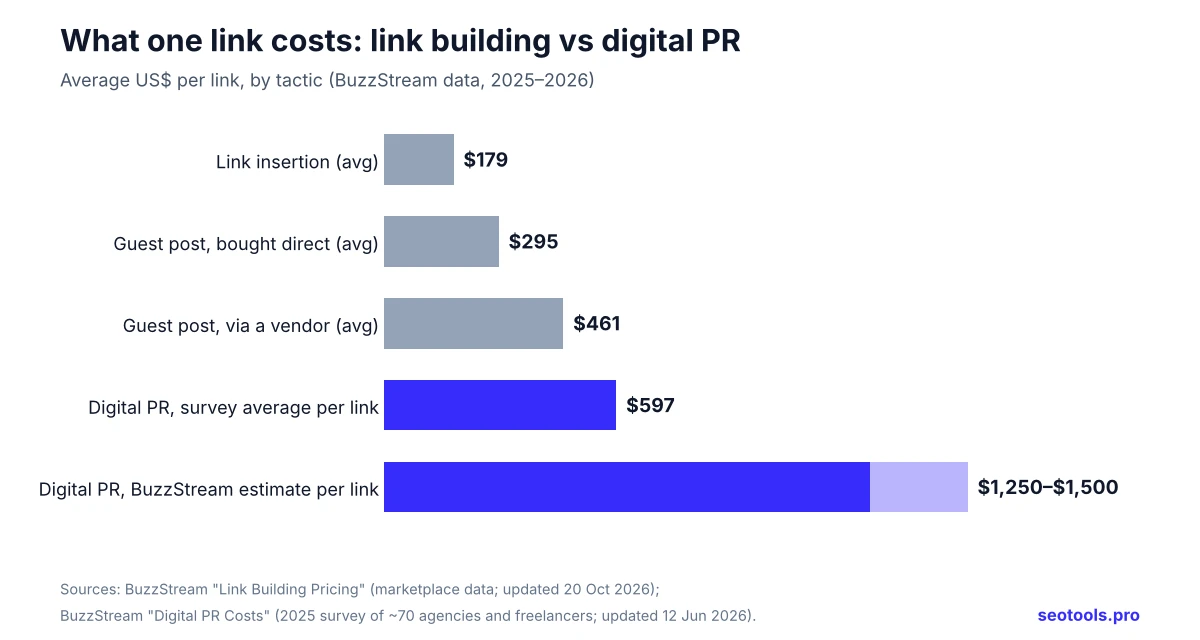
What the numbers say:
- Link building: link insertions average $179 and guest posts $295 bought direct or $461 through a vendor. BuzzStream puts a typical vendor link at "about $500".
- Digital PR, survey: ~70 agencies and freelancers report $597 per link on average, on contracts averaging about $5,458 a month.
- Digital PR, estimate: in its link building pricing guide, BuzzStream estimates $1,250–$1,500 per link. It says a $5,000–$10,000 campaign "typically nets 6 to 7 unique linking root domains."
Note the gap: BuzzStream's survey average ($597) and its own estimate ($1,250–$1,500) differ by 2 to 2.5 times.
Treat any single price as a rough guide, not a quote.
Price per link also hides the real difference. A guest post gives one link you control. A good PR story can also bring mentions, traffic and brand searches.
Why Digital PR Is Harder Than It Looks
Digital PR depends on busy journalists. Muck Rack's 2026 survey of journalists shows how hard it is to get a reply:
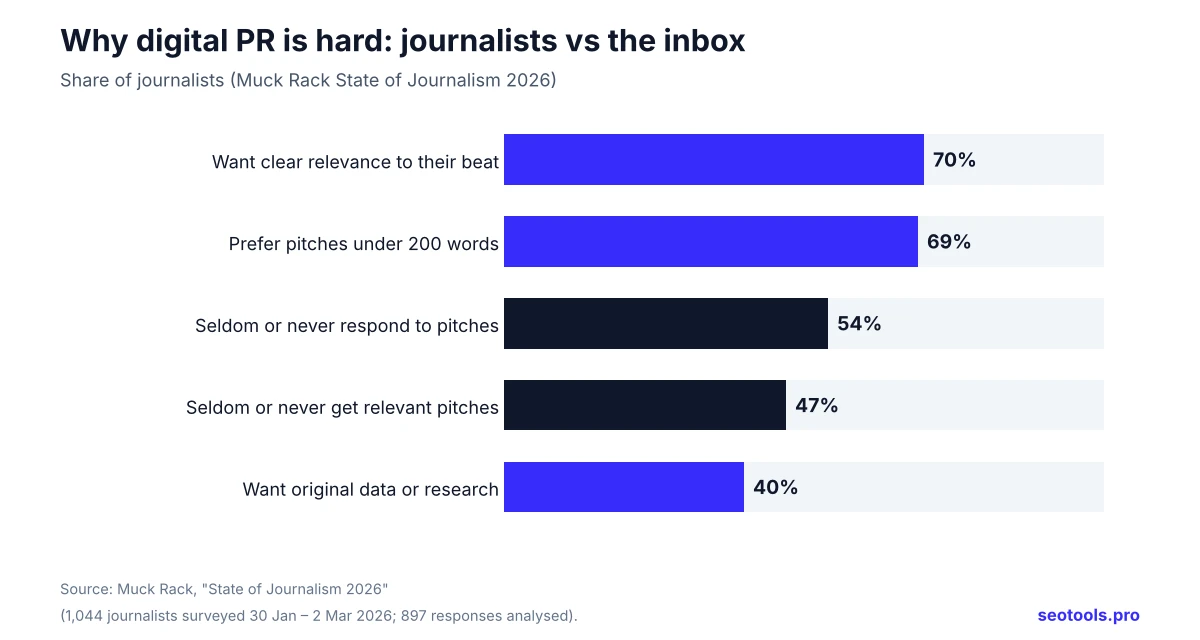
- 54% seldom or never respond to pitches.
- 47% seldom or never get pitches that match what they cover.
- 69% prefer pitches under 200 words.
- 70% want clear relevance to their beat. 40% want original data or research.
The lesson: digital PR is a story business. Without fresh data or a real expert, a campaign is just a press release with a bigger invoice.
Links, Mentions and AI Answers
AI search adds a new reason to care about digital PR. AI tools often name brands they see discussed across the web.
Ahrefs studied 75,000 brands and their visibility in Google's AI Overviews. Brand web mentions showed the strongest correlation:
- Branded web mentions: 0.664
- Branded anchors: 0.527
- Branded search volume: 0.392
- Domain Rating: 0.326
- Referring domains: 0.295
- Backlinks: 0.218
The author is clear that "correlation ≠ causation". The study also covers Google AI Overviews only, not ChatGPT or Perplexity.
Still, the pattern fits common sense. Being talked about tracks AI Overview visibility more closely than raw link counts do. Digital PR creates talk. Link building mostly creates links.
Want to see where you stand? The free AI Visibility Checker shows whether AI answers mention or link to your brand.
How to Choose: Link Building, Digital PR or Both
Choose link building when:
- You have strong pages stuck on page 2 that need a push.
- You work in a niche topic journalists rarely cover.
- You need predictable volume and want to choose the sites.
- Your budget fits a few links a month, not a full campaign.
Choose digital PR when:
- You have data, research or an expert worth quoting.
- You want brand authority, trust signals and AI mentions, not just links.
- Competitors have big-name media links you can't match with outreach.
- You can wait for results and accept that some pitches miss.
Use both when: you have money pages to rank and a brand to build. A common pattern is steady link building for key pages plus a few PR campaigns a year.
Check This Before You Pay for Either
Whatever you buy, a few free checks stop most bad deals.
- Look at what competitors earned. Run their domains through the free Backlink Analyzer. News-site links usually point to PR; blog links usually point to outreach.
- Check demand for your topic. Use Keyword Research to confirm the pages you'll link to target real searches.
- Vet every site. Ask for real traffic, topic fit and a live example page. A high DR number alone means little.
- Ask how paid placements are marked. If a provider says paid links never need rel="sponsored", that's a policy risk you carry.
- Agree on reporting. Live link list, linking page, anchor, and for PR, the coverage and mentions too.
Here's what our own keyword data showed for "digital pr" in the US this month:
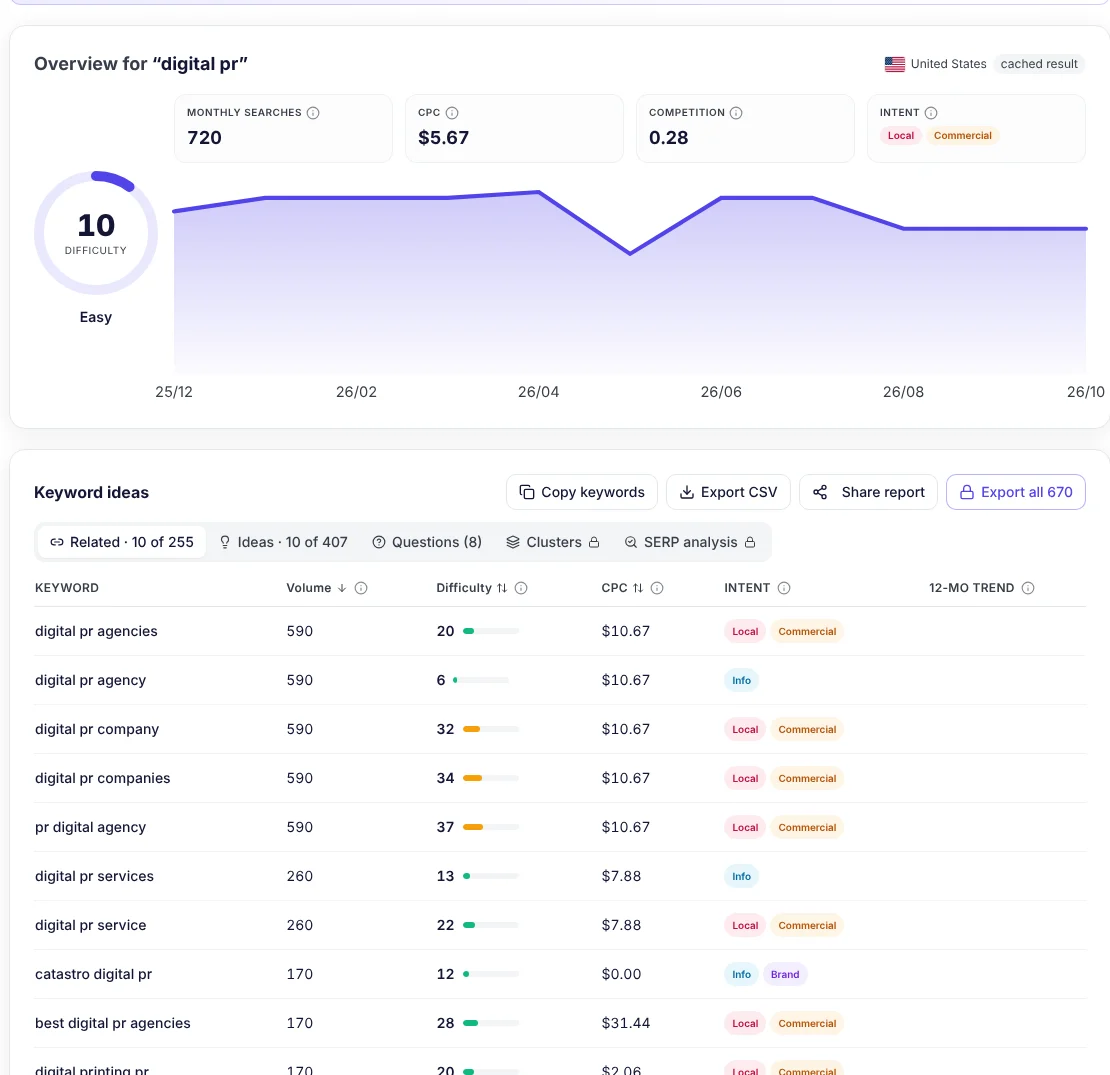
"Digital pr" gets 720 US searches a month, with easy difficulty (10). "Link building" gets 1,900, with medium difficulty (55).
Buyer terms show the same gap: "digital pr agency" gets 590 searches and "link building services" 1,600.
Sorting through sites to pitch or place on? The seotools.pro marketplace lists 600K+ sites with DR, traffic and topic data, so you can compare before you spend.
How seotools.pro Can Help
We run both services, and we'll tell you honestly which one fits your site first.
- Link building: relevant, in-content placements on real editorial sites, and you approve every site.
- Link building packages: fixed tiers from 2 to 60 vetted links, with live-link reports.
- Digital PR: data-led studies, reactive commentary and journalist outreach that turn into mentions AI engines repeat.
Pricing depends on your site and goals. Book a free consultation with Anatolii Ulitovskyi to get a plan for your links and PR.
Check any domain's backlink profile in seconds and spot whether their wins came from outreach or press.
- Backlinks, referring domains and dofollow split
- Strongest links ranked by authority
- 3 free checks a day, no signup
- Works on any domain
The Verdict
Link building buys control. Digital PR earns reputation. They solve different problems.
If your pages are good but under-linked, start with careful link building. If your brand is invisible in the press and in AI answers, start with digital PR.
Either way, follow Google's rules on paid links and judge every link by the site's real audience, not its DR.
FAQ
What is the difference between link building and digital PR?
Link building gets links to chosen pages through outreach and placements. Digital PR earns news coverage with stories, data or expert comment, and the links come with it.
Is digital PR better than link building?
Not always. Digital PR usually brings stronger, more trusted links and brand mentions. Link building is cheaper per link and lets you target specific pages. Many sites need both.
How much does a digital PR link cost?
In BuzzStream's 2025 survey of about 70 agencies and freelancers, the average was $597 per link. BuzzStream separately estimates $1,250–$1,500 per link.
Are paid guest posts against Google's rules?
Paid links that pass ranking credit are link spam under Google's spam policies. Mark paid placements with rel="sponsored" or rel="nofollow".
Does digital PR help with AI search?
It can. In an Ahrefs study of 75,000 brands, branded web mentions had the strongest correlation with Google AI Overview visibility. Correlation isn't proof of cause.
Sources
Google rules: Google Search Central, "Spam policies for Google web search" (last updated 28 August 2026); "Qualify your outbound links to Google".
Mueller quotes: digital PR (Jan 2021), guest posts (June 2020), press releases (June 2018), via Search Engine Roundtable.
Illyes on links: Search Engine Land (Pubcon, September 2023).
Costs: BuzzStream, "Link Building Pricing" (updated 20 Oct 2026); BuzzStream, "Digital PR Costs" (updated 12 Jun 2026).
Journalists: Muck Rack, "State of Journalism 2026". AI visibility: Ahrefs, AI Overview brand correlation study (May 2025).
Keyword data: seotools.pro Keyword Research, United States, 31 October 2026.