NerdWallet's Google traffic would cost about $27M a month if it bought the same visits as ads.
It gets about 6.6M visits a month from Google in the US. Money searches cost a lot to buy as ads, so each visit is worth a lot.
We ran NerdWallet through our whole SEO toolkit to see how a finance site earns that kind of traffic.
Here are 9 lessons you can copy, plus the part you can't.
Go after searches worth money
We started with our Domain Overview. It shows a site's organic traffic, meaning the people who find it on Google without ads, plus what that traffic is worth.
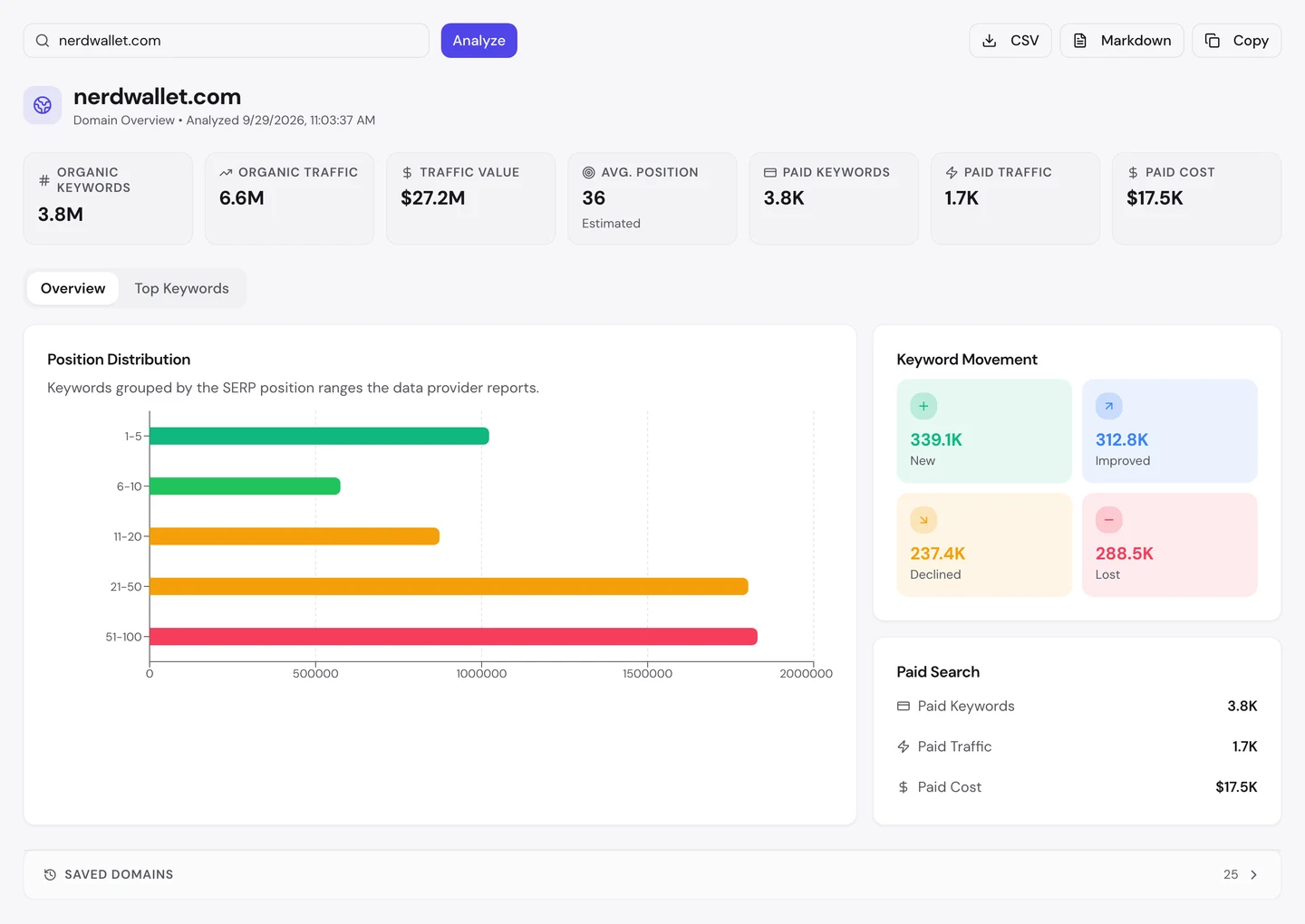
Traffic value is what the same visits would cost if you paid Google for them as ads. For NerdWallet, that's about $27M a month.
Its ad bill is tiny next to that, about $18K a month. Almost all of its visitors come free, from search.
Why so much? Banks and insurers pay a lot for every click on searches like "car insurance quotes".
NerdWallet ranks for those same searches without paying. You can do the same in your own niche.
Our Organic Traffic Checker shows which pages bring the visits in.
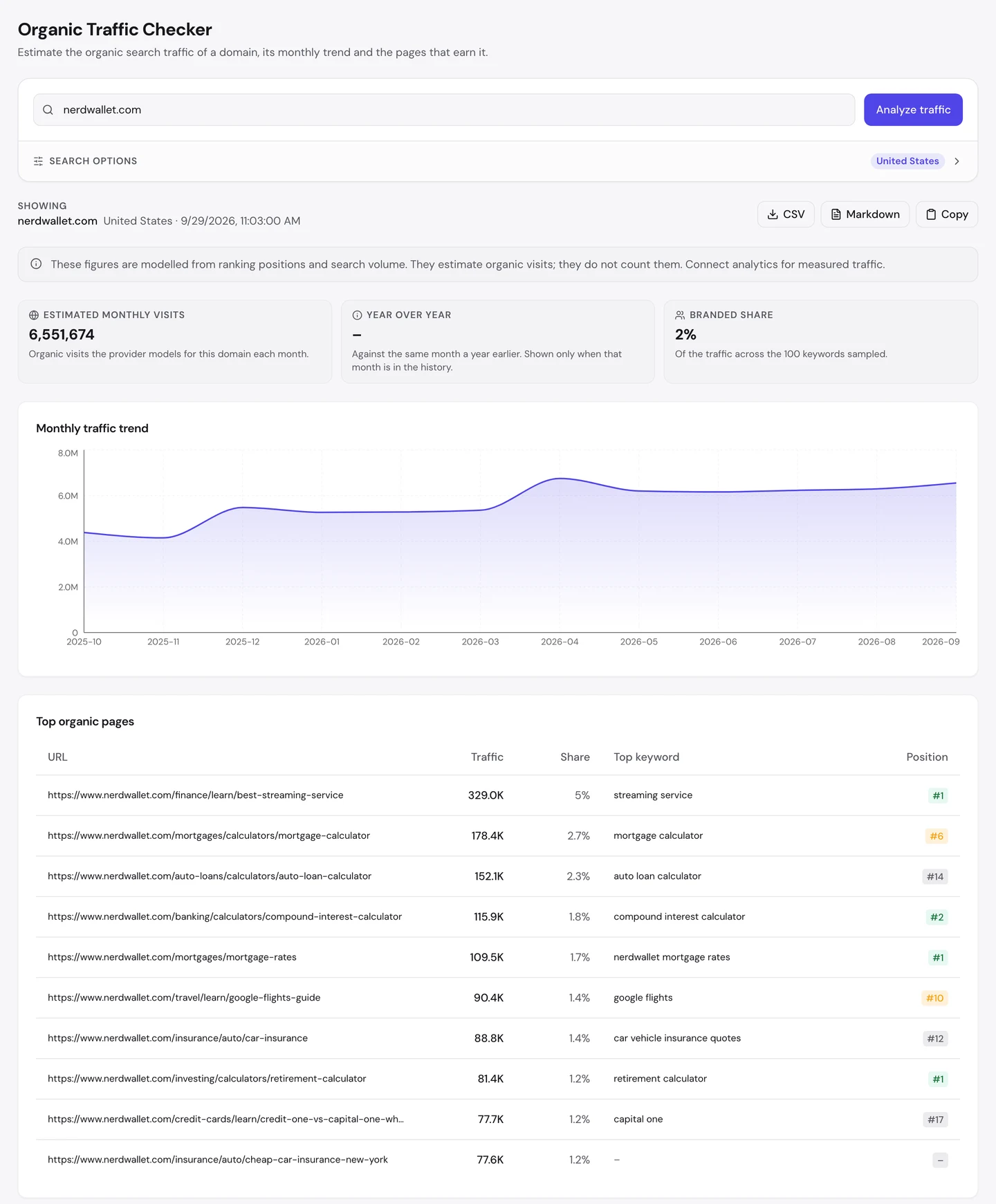
Only 2% of the traffic comes from people searching for the name NerdWallet. Everyone else arrives with a money question, like the ones you ask yourself before a big purchase.
The Traffic tab of our Website Audit adds one more detail.
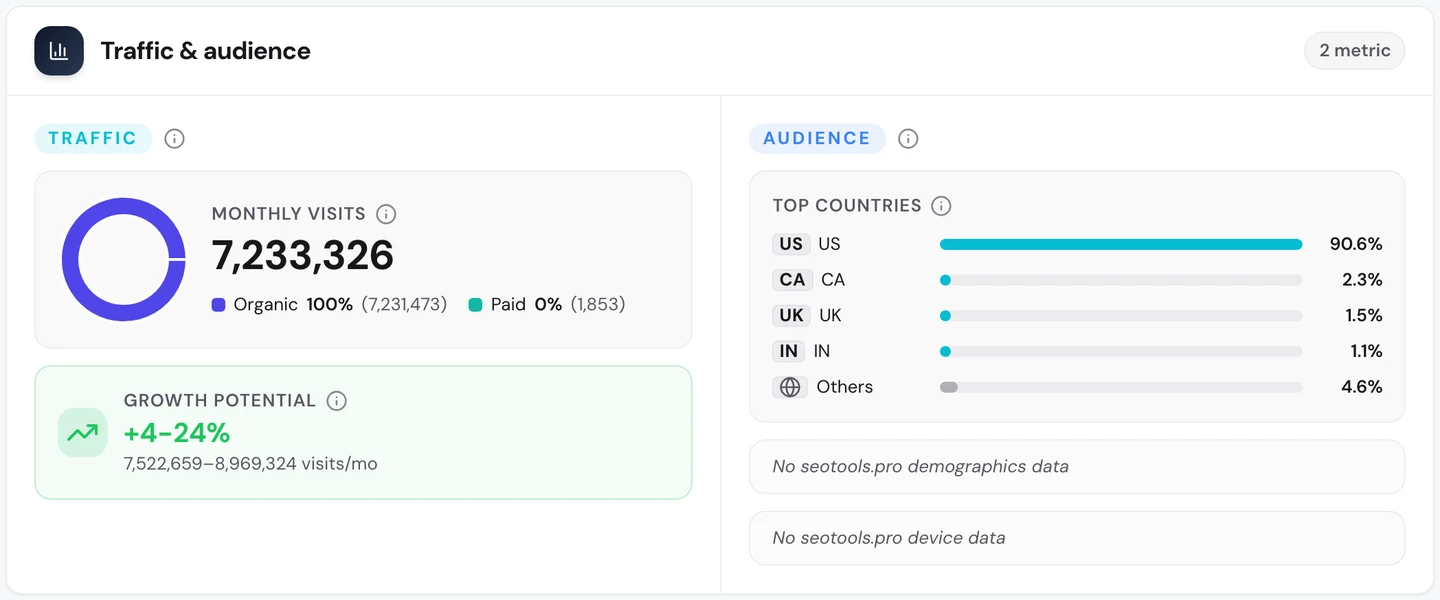
9 in 10 visits come from the US. Wise, the money app we also studied, is the opposite: the US sends it fewer than 1 in 10.
So check what your own searches are worth. Our Keyword Research tool shows what each click costs as an ad, and a high price means buyers are close to spending.
Build calculators people reuse
Look at the top 10 pages again. 4 of them are calculators: mortgage, car loan, compound interest and retirement.
Here's the mortgage one.
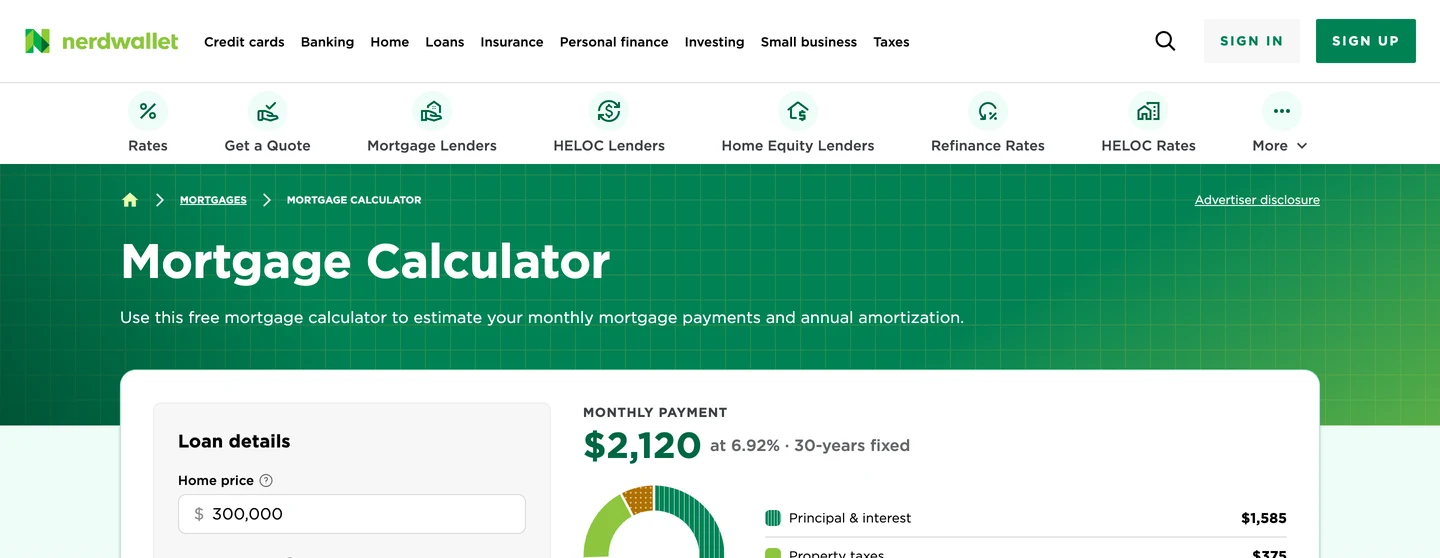
You type in a home price and a down payment, and your monthly payment shows up right away. You don't need to read a thing first.
You come back to a tool like this again and again as your plans change. And every visit is a chance for NerdWallet to show you a loan or a card.
Calculator.net, the free calculator site we studied on its own, gets 11M visits a month from tools like this.
So find the sums your buyers do by hand. Each one could be a free calculator on your site.
4 of NerdWallet's top 10 pages are calculators. We build free tools like these for your site, so people who are about to buy find you first and come back.
- We find the sums your buyers search for
- We design a tool that answers them in seconds
- We add clear help text so the page can rank
- SEO and GEO, so AI answers can quote it too
Write about everyday spending
Here's the surprise. NerdWallet's biggest page isn't about loans or cards.
It's a guide to picking a streaming service, the kind of thing you might search on a Sunday night.
The Keywords tab of our audit lists every search a site ranks for, where it ranks and how many visits each one sends.
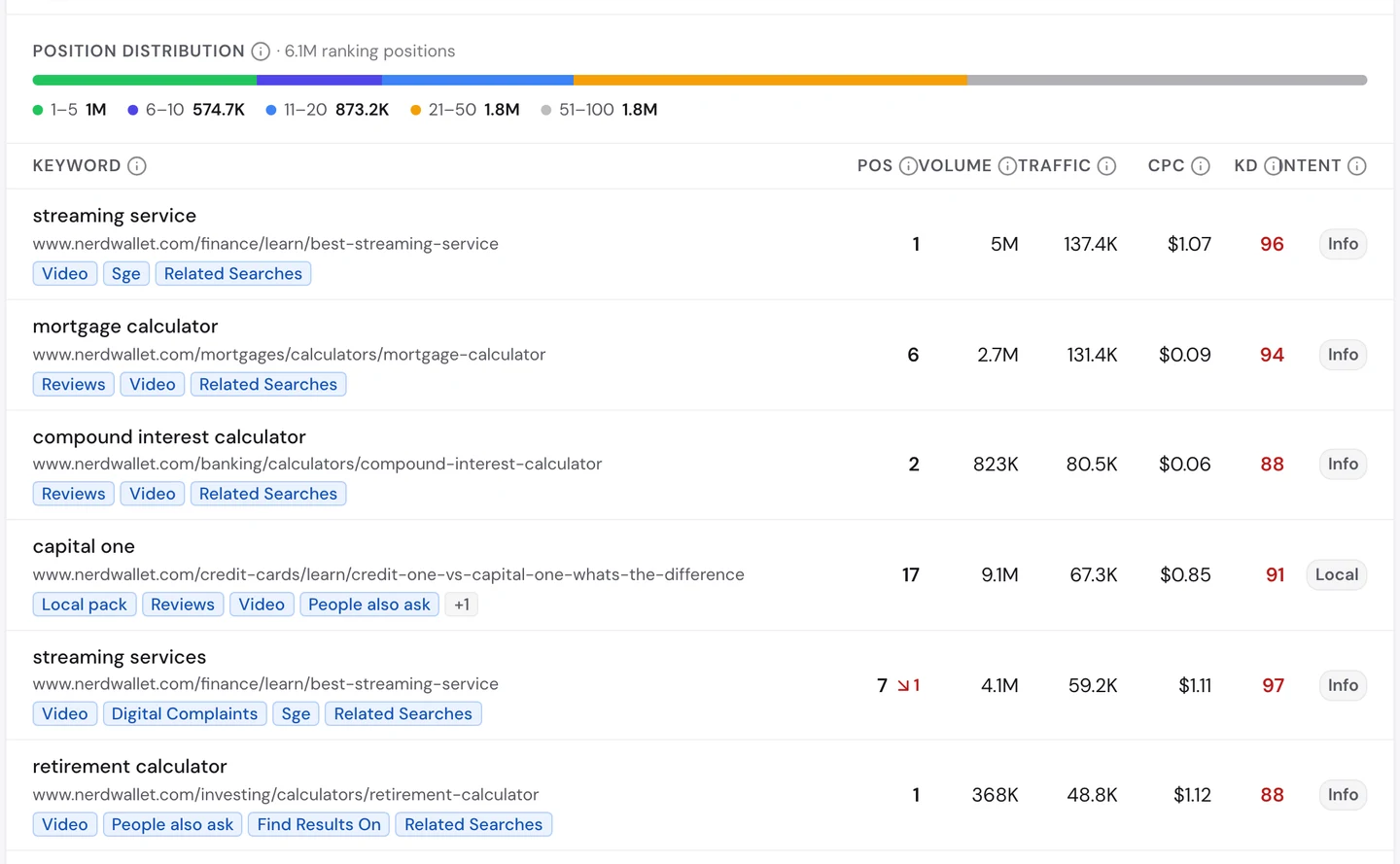
"Streaming service" is searched about 5M times a month, and NerdWallet ranks first. The page compares what Netflix, Hulu and the rest cost, and it has its own cost calculator.
That's still a money topic. It's just one that you, and millions of others, think about every month.
So don't stop at your core product. Write about the everyday spending your buyers already search for, and tie it back to your topic.
Show who wrote and checked it
Money advice can hurt people when it's wrong. So Google holds finance pages to a higher bar, and it looks for signs that real experts are behind them.
NerdWallet puts those signs right at the top.
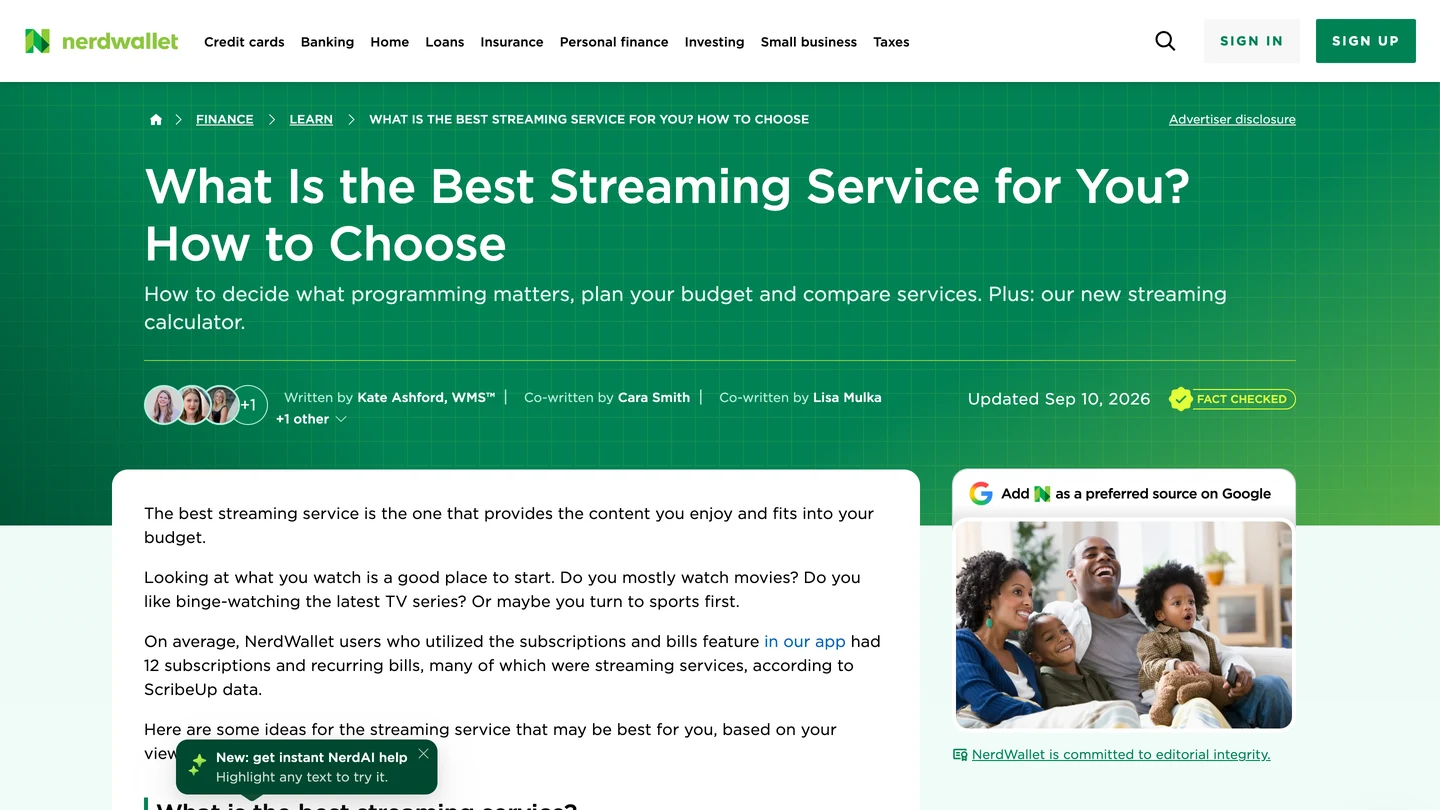
You can see who wrote the guide, when it was last updated and a "fact checked" badge. Healthline, the health site we studied, does the same with its medical reviewers.
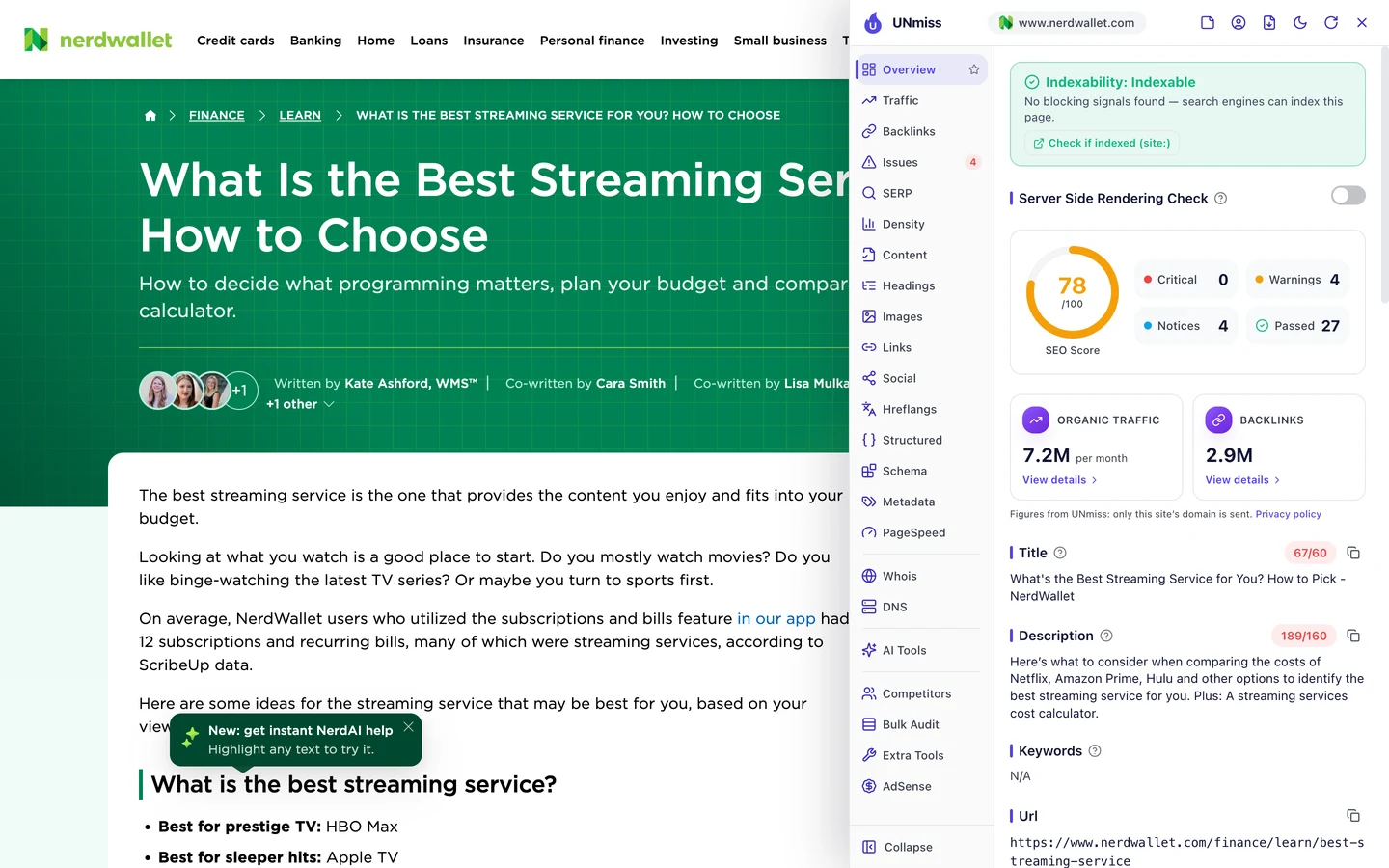
Our free browser extension shows the rest in one click. Open the page, click the UNmiss icon, and a panel opens beside it.
It runs 35 SEO checks and scores this guide 78 out of 100, with no critical problems.
The Structured tab shows the hidden part. The page carries structured data, code that tells Google what a page is, and here it says "article" and names the publisher.
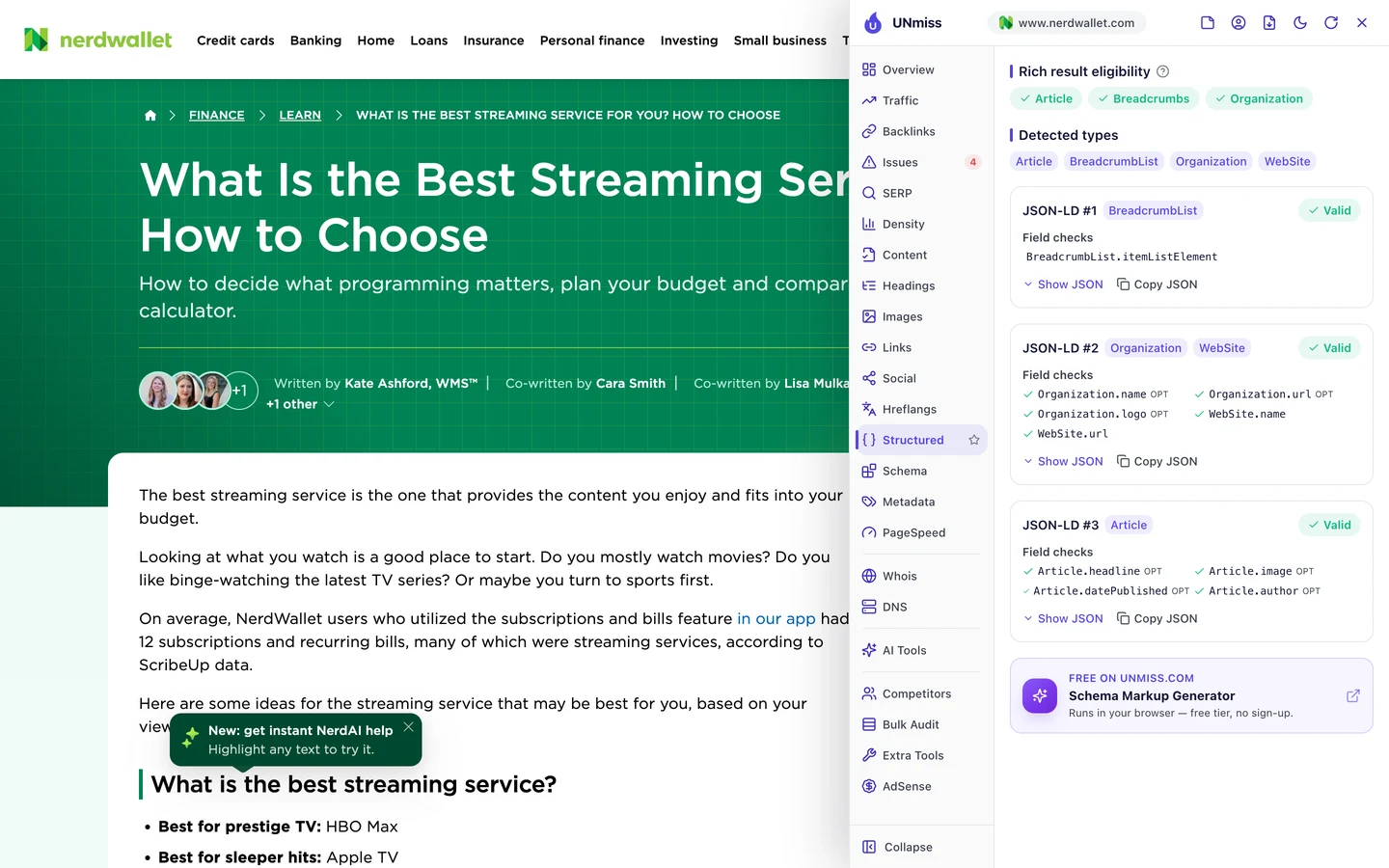
You can add the same code with our Schema Markup Generator. Then put real names and a real update date on every page you publish.
Earn links with useful answers
A backlink is a link from another website to yours. Google treats each one a bit like a vote of trust.
The Backlinks tab of our audit shows the same data as our Backlink Analyzer.
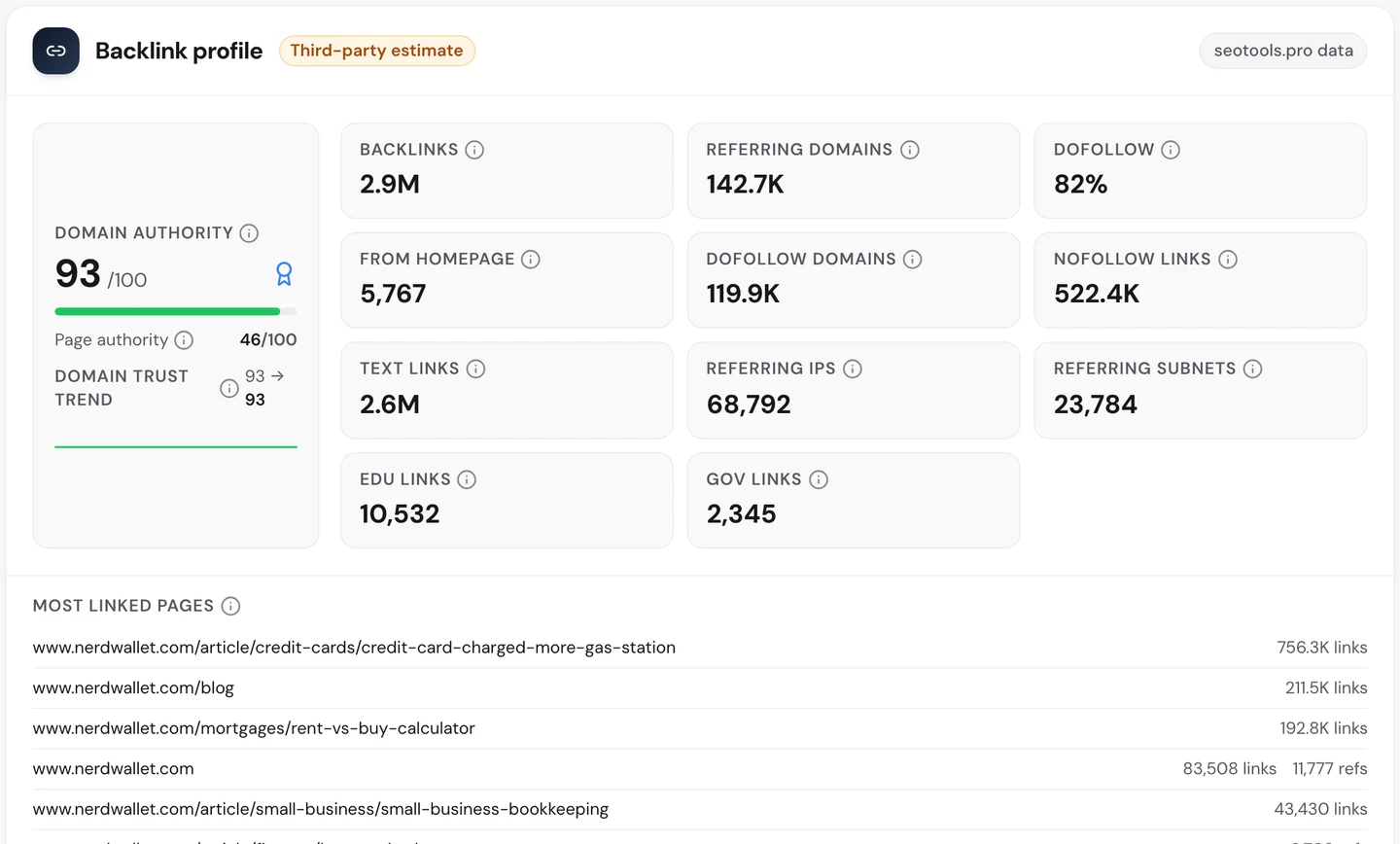
NerdWallet has about 2.9M links from more than 140K websites. And the most linked page isn't a product page.
It's an article about gas stations charging more when you pay by card, with about 756K links. It answers a small, annoying question, so people share it.
The rent vs buy calculator comes third, with about 193K links. Useful tools get linked, just like useful answers.
Both pages have since moved to new addresses. NerdWallet points the old ones to the new pages, so those links still count.
So write the answer people want to pass on. And when you move a page, always redirect the old address.
Audit for broken images and links
With thousands of pages built from a few templates, one mistake spreads fast. So we checked NerdWallet with our Website Audit.
It crawls a site the way Google does. It opens each page, follows the links to the next ones, and tests every page against a long list of checks.
We had it crawl 250 pages. NerdWallet scored 87 out of 100, which the report rates as good.
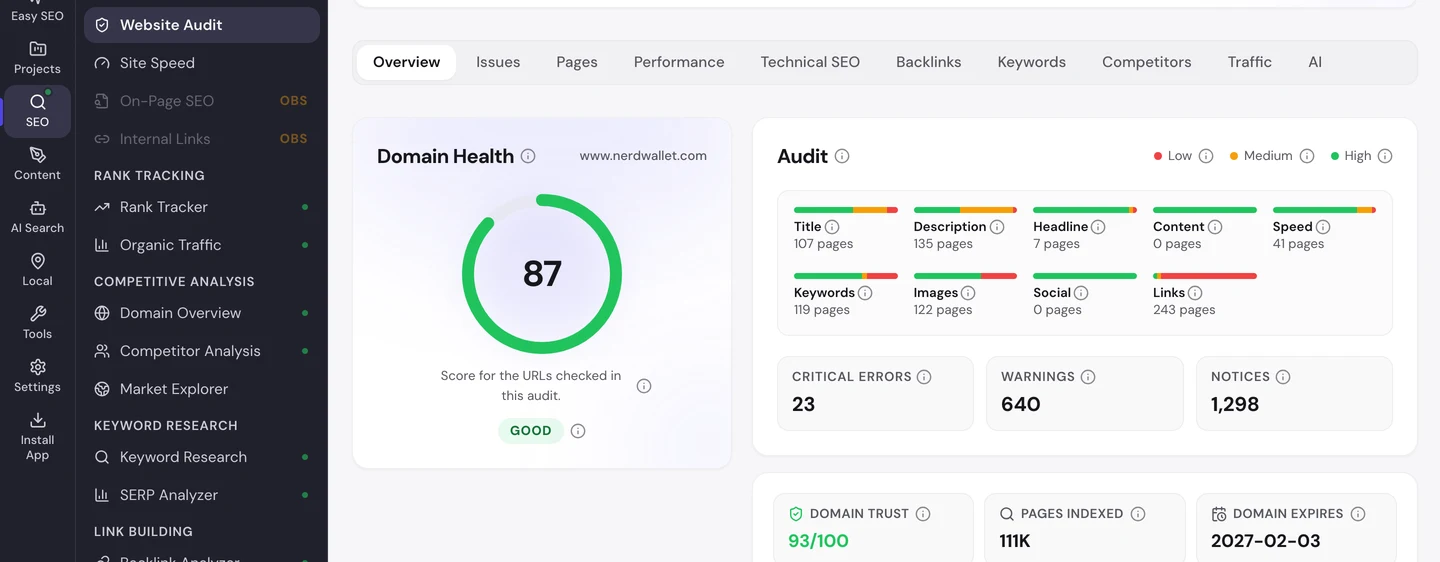
The Issues tab sorts the problems by how much they matter.
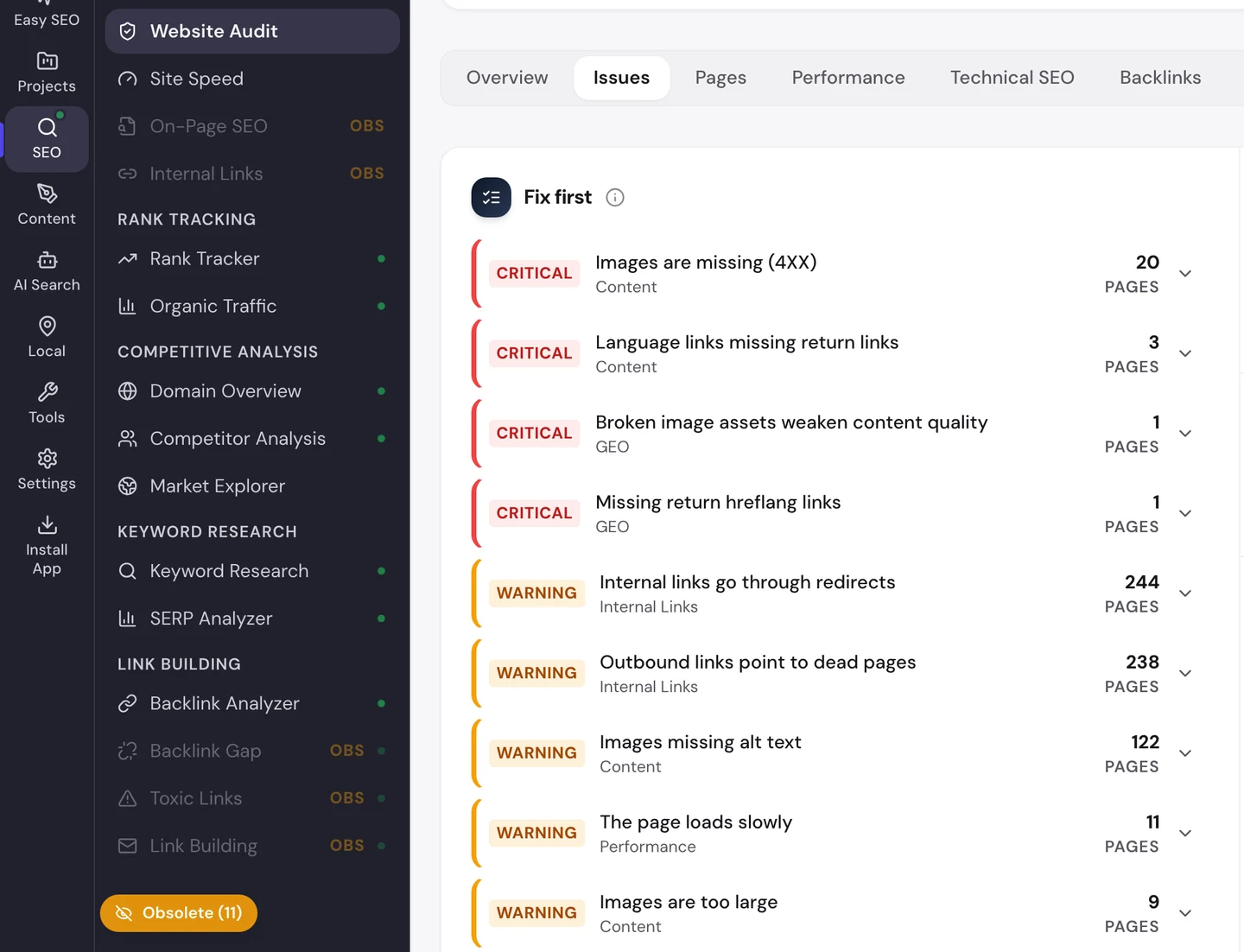
The top error is missing images, on 20 pages. The biggest warnings are links that go through redirects, and links out to pages that no longer exist.
Broken images and dead links make your pages look old and unloved, to readers and to Google.
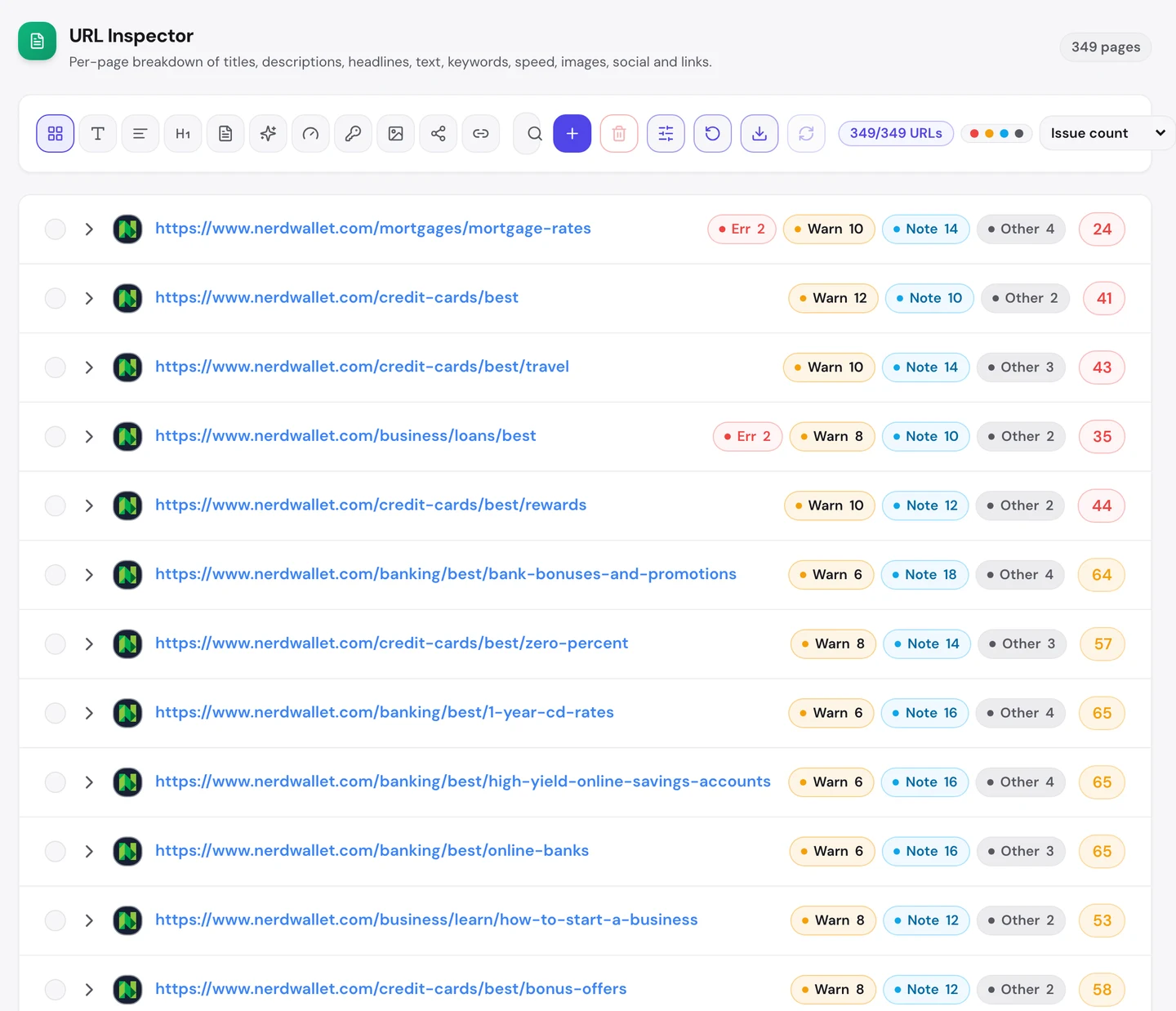
The Pages tab shows which pages need the most work. Several of NerdWallet's credit card and loan pages score under 45 out of 100.
The Technical SEO tab checks which pages Google may list. It found 230 of them missing from NerdWallet's sitemap, the file that lists a site's pages for Google.
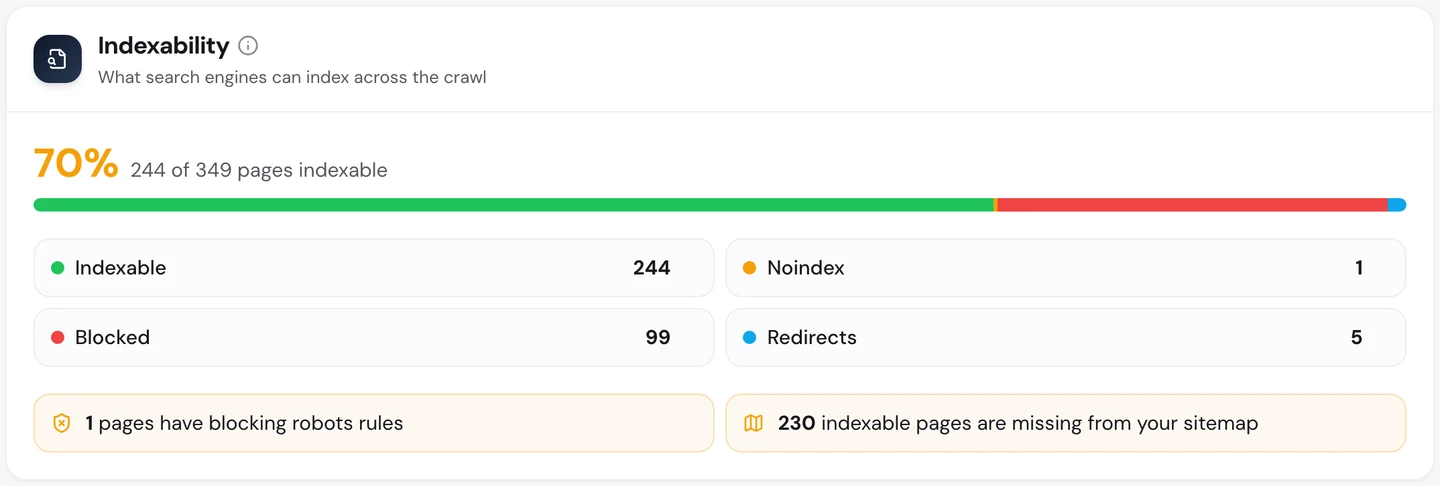
Google can still find those pages through links. But a complete sitemap helps new and updated pages get found faster.
Our extension found smaller things on the streaming guide itself.
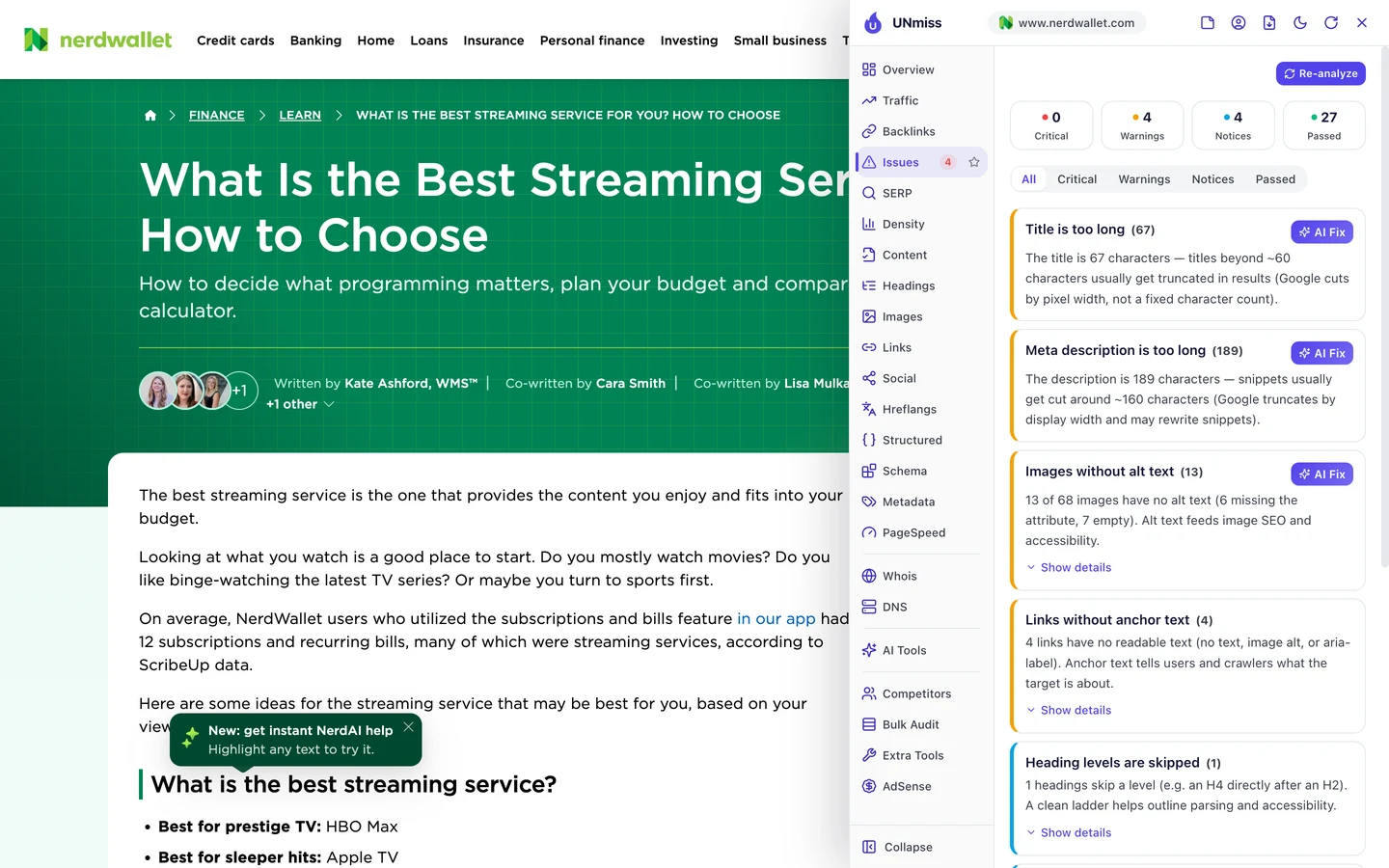
Its title and description are both too long, so Google cuts them off in the results. That's a quick fix with our Meta Tag Generator.
You don't have to work out the order yourself. The audit's AI tab writes the plan: a short summary, each problem with how to fix it, and a 90-day to-do list.
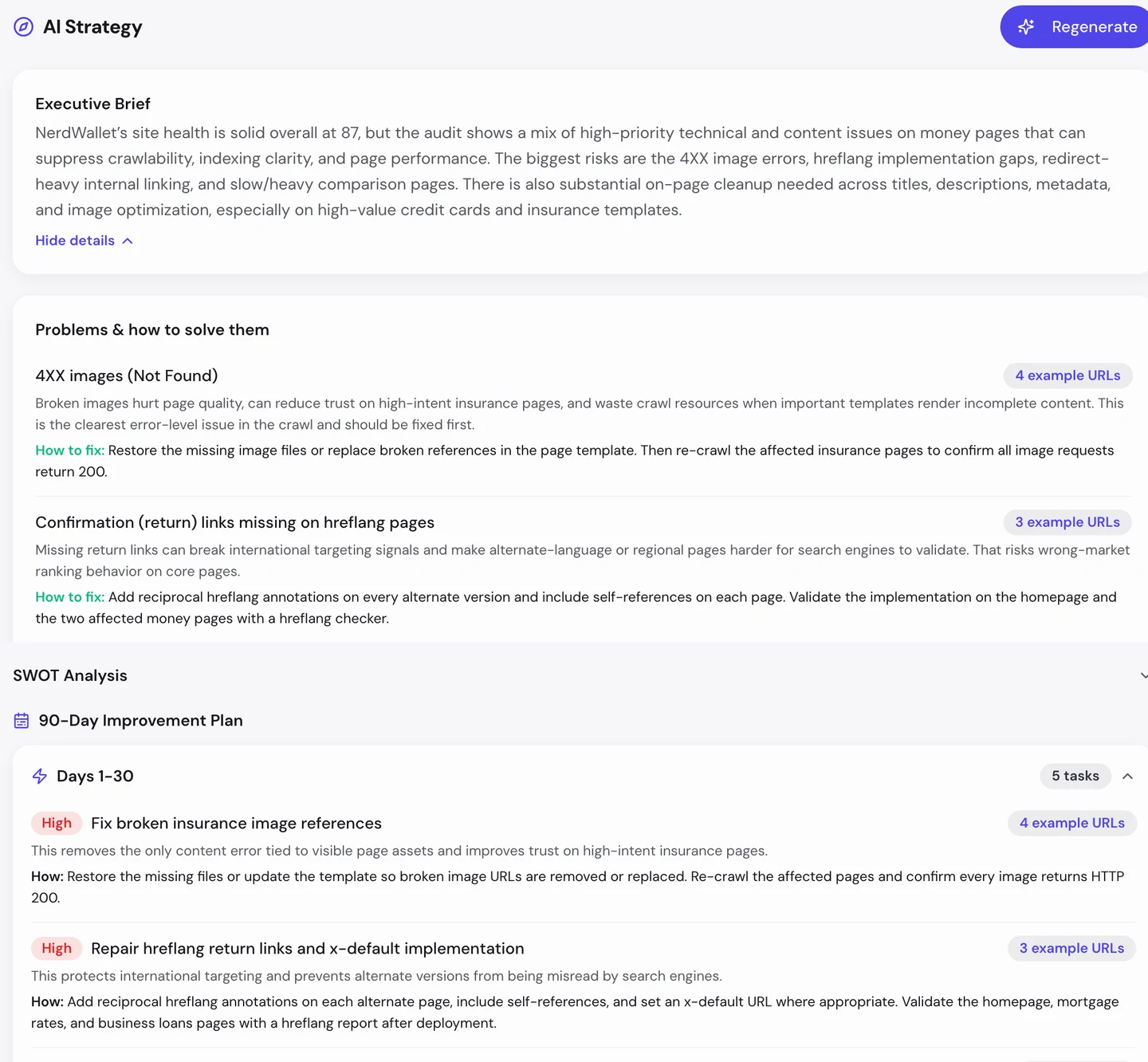
For NerdWallet, the first month goes to the broken images on its insurance pages and the missing language links.
So run an audit every month, and fix the errors that repeat first. One template fix can clear hundreds of pages at once.
Keep pages fast for real users
The Performance tab of the audit shows Core Web Vitals. These are Google's 3 checks of how fast a page loads, how fast it reacts and whether it stays still, measured on real visitors' devices.
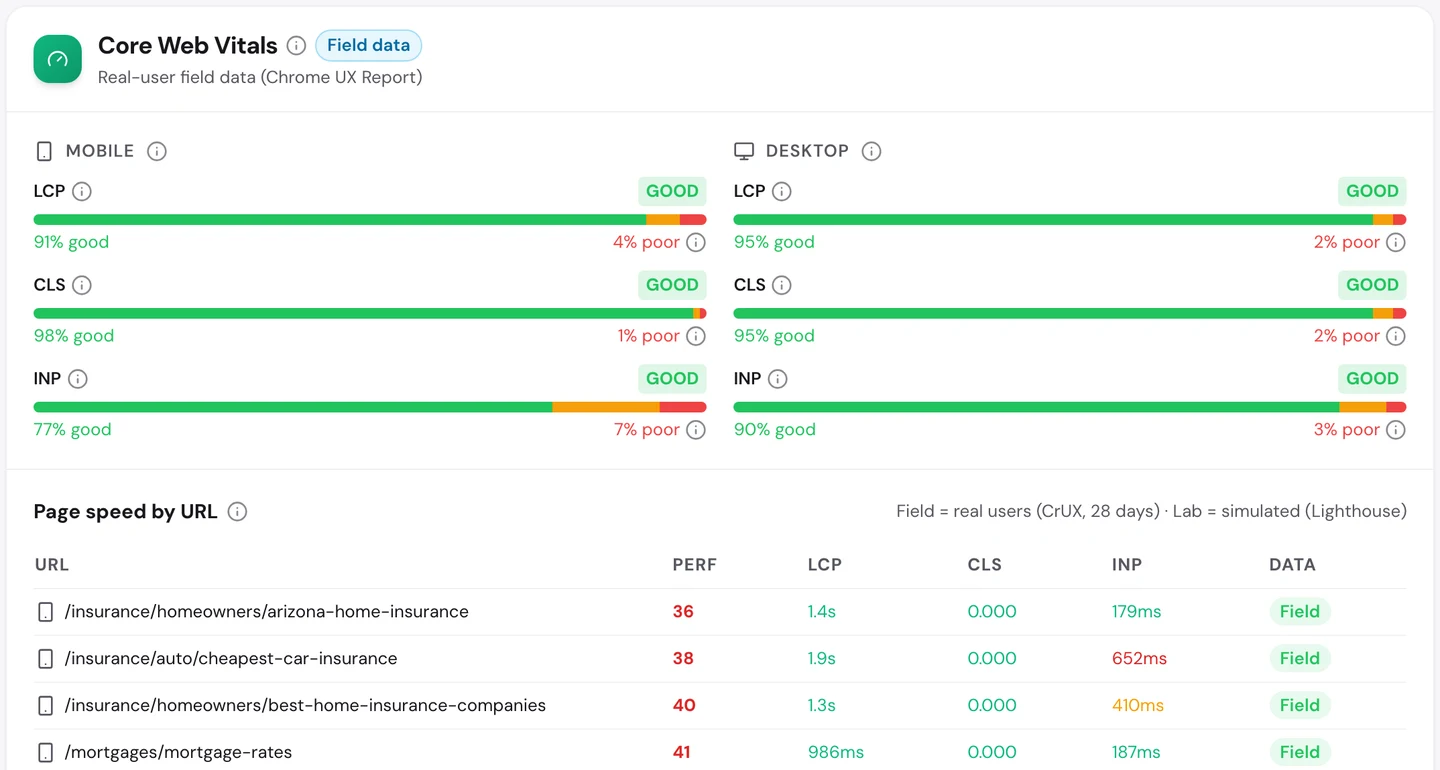
NerdWallet passes all 3, on phones and on desktops. That's hard to do on pages full of tools and rate tables.
Wise, by comparison, fails the check for how fast its pages react on phones.
So test your heaviest pages, the ones with tools and tables, on a real phone. Our Site Speed tool shows what slows each page down.
Know who shares your searches
The audit's Competitors tab lists the sites that rank for the same searches as you.
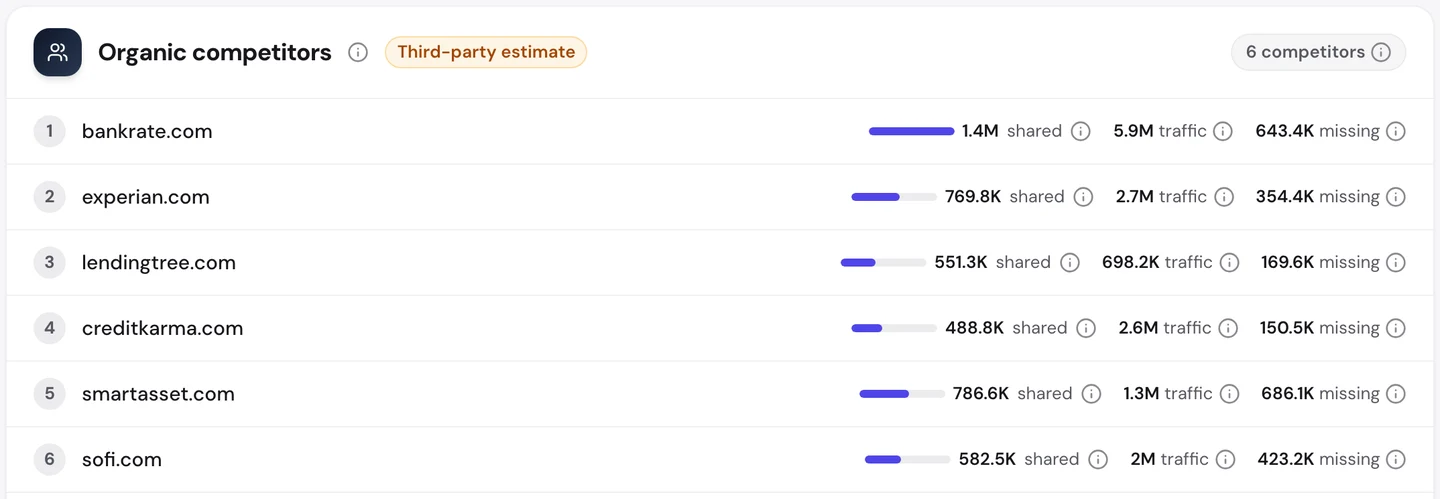
Bankrate shares about 1.4M searches with NerdWallet. Experian, LendingTree and Credit Karma follow.
These sites answer the same money questions, so every ranking is a fight. If you slip a single place, you can lose thousands of visits.
So pick the searches that matter most to you, and watch them in our Rank Tracker. You'll see a rival pass you in days, not months.
Plan for AI answers
NerdWallet's CEO has said that Google's AI answers are taking clicks away from sites like his. People get a short answer at the top of Google and never click.
Yet our traffic chart shows NerdWallet climbing again, from about 4M to 6.6M visits a month over the past year.
Those AI answers come from crawlers, programs that visit pages and read them. The rules for them live in robots.txt, a file that tells crawlers what they may read, and our extension reads it for you.
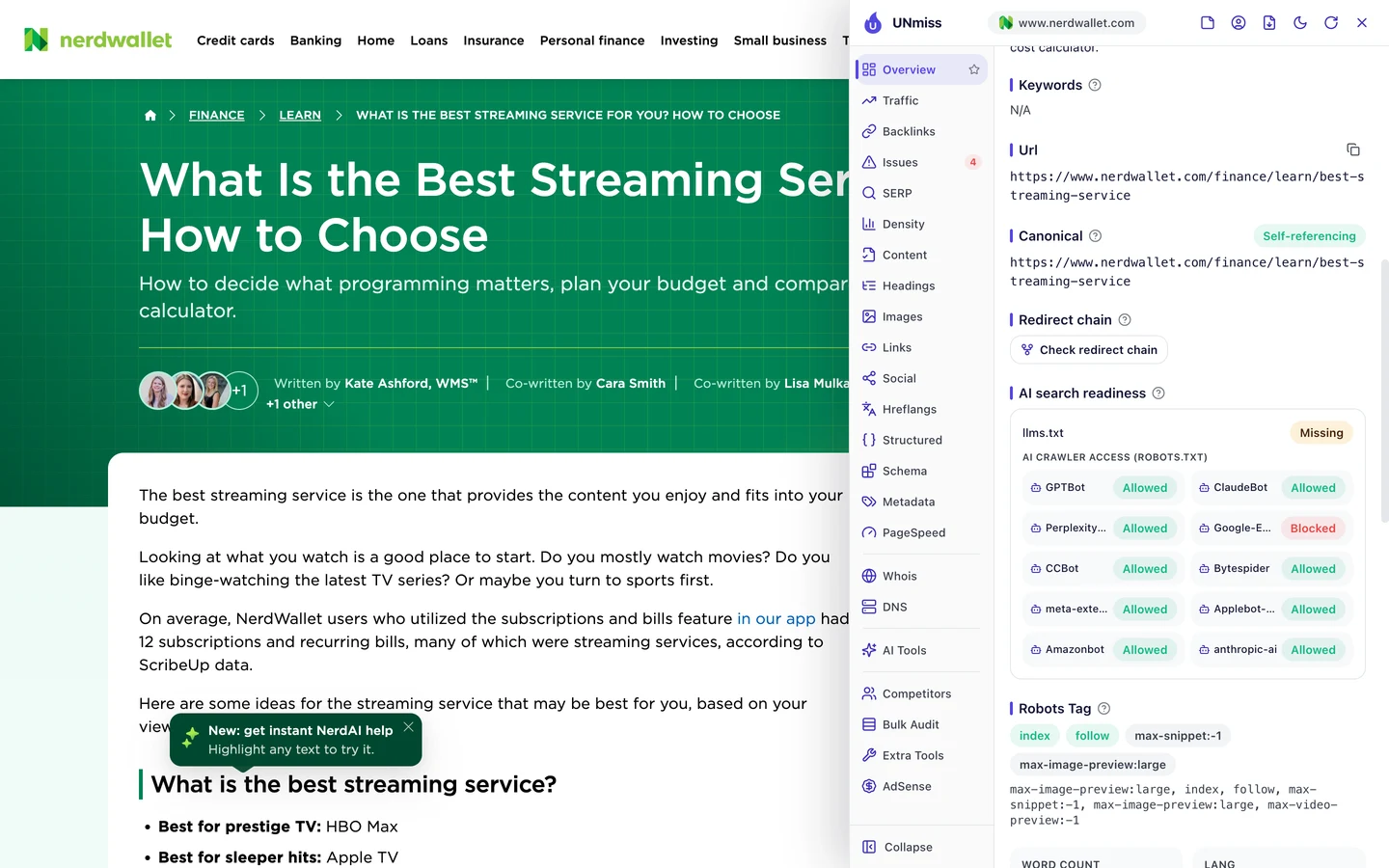
NerdWallet lets in every AI crawler except Google's own, called Google-Extended. So ChatGPT and Claude can read its pages and quote them.
Decide on purpose which AI tools may read you. Write your rules with our robots.txt generator, then check whether AI tools mention you with our AI Visibility Checker.
NerdWallet's search traffic is worth about $27M a month. Our Domain Overview shows your organic traffic, its value in ad money, and how many keywords you're winning and losing.
- The same report that measured NerdWallet
- Traffic, traffic value and keyword movement
- Run it on any rival's domain too
What you cannot copy
First, the part you can't copy: a big team of writers and fact checkers who cover money full time.
That took NerdWallet years to build. A small site can start with one expert and its most important pages.
Now a few honest notes on the numbers.
We took our figures on 29 September 2026. The 6.6M figure counts US searches, and the $27M is a traffic value, not NerdWallet's revenue.
Both are estimates. Nobody outside NerdWallet can count its real visits, so tools work them out from rankings and search volume.
Some NerdWallet pages showed our extension a "noindex" tag, which tells Google not to list a page. That's the site guarding itself against automated browsers.
Google and normal visitors get "index", so we left it out.
We set the crawl to 250 pages, a sample of a very big site. So we used it to find problems that repeat, not to count every error.
The one number to take away
$27M.
That's what NerdWallet's search visits would cost as ads, every month. It gets them by answering money questions, from mortgage payments to streaming bills, better than most of its rivals.
That's the lesson for any business. The searches that cost the most to buy are the ones most worth earning.
Know a sum your customers work out by hand? That could be your first calculator.
You can run every one of these checks on your own site, and on your rivals', and see the same numbers for yourself.
Frequently asked questions
Can a small site rank for expensive money searches?
Rarely for the broadest ones, like "credit cards". Start with narrow questions that big sites answer only briefly, like a fee in your state or a calculator for one kind of loan, and grow from there.
How does NerdWallet make money?
Mostly from partners. When a reader opens a card or takes a loan through a NerdWallet link, the bank or lender pays it a fee. That's why its free guides sit so close to its product lists.
Do I need to be a finance expert to write about money?
For advice that affects people's savings, you should have one check your work. Name them on the page and say what they checked. For simple topics, clear sources may be enough.
How hard is it to build a simple calculator?
A basic one can take a developer a day or two, and some website builders have ready-made widgets. The hard part is the help text around it, which is what helps the page rank.
Should I write about topics outside my product?
Only if your buyers care about them and you can tie them back. A money site writing about streaming bills works. A money site writing about recipes doesn't.
Will AI answers kill my search traffic?
They take some clicks, mostly on simple questions. Pages with tools, fresh data or deep answers still get visited. Check which of your searches now show an AI answer, and watch the clicks on those pages.
Are affiliate links bad for SEO?
No, as long as you mark them properly and the page helps the reader. Google cares about pages that exist only to push links with little real advice.
How often should I update money pages?
Whenever rates, fees or rules change, which in finance can be monthly. Show the date you updated it, and change the date only when you've changed the content.