An agency offers you "GEO services". Another says SEO already covers AI answers. A third sells both as separate retainers.
So what's the real difference, and do you need to pay for both?
Google's own answer is short: optimizing for its AI features "is optimizing for the search experience, and thus still SEO."
But Google isn't the only AI that answers your customers. This guide shows what GEO really adds, what's just hype, and how to check where you stand for free.
SEO services help your pages rank and get clicks in search results. GEO services aim to get your brand named and cited in AI answers like Google AI Overviews, ChatGPT and Perplexity.
The foundation is the same: a crawlable site, useful content and a trusted brand. Google says GEO for its AI features is still SEO.
Buy GEO as an add-on to solid SEO, not as a replacement. The parts worth paying for: AI crawler access, real brand mentions and measuring AI visibility over time.
- Google's 2026 guide to its AI features (updated July 2026) says llms.txt files, "chunking" and special schema aren't needed for its AI features.
- ChatGPT is different. OpenAI says sites that block OAI-SearchBot won't be shown in ChatGPT search answers.
- Google Search Console and Bing Webmaster Tools now report AI visibility. You can measure GEO without guessing.
- In Pew Research data, people clicked a result in 8% of visits with an AI summary vs 15% without one.
- Walk away from anyone who guarantees AI citations or claims access to "internal" Google metrics.
SEO vs GEO services at a glance
| SEO services | GEO services | |
|---|---|---|
| The goal | Rank pages in search results and earn clicks | Get your brand named and cited in AI answers |
| Where it shows | Google and Bing results pages | AI Overviews, AI Mode, ChatGPT, Perplexity, Gemini, Copilot |
| Main work | Technical fixes, keyword-matched pages, links | The same, plus AI crawler access, brand mentions and AI visibility tracking |
| Measured by | Rankings, clicks, conversions | Mentions, citations, AI impressions, then conversions |
| Free reports | Google Search Console, Bing Webmaster Tools | Search Console Generative AI reports, Bing AI Performance |
| Honest promise | Scope and quality of work, not #1 rankings | Scope and measurement, not citations |
What SEO Services Do
SEO services make your pages easy to find, easy to read and worth ranking in classic search results.
A typical SEO project covers:
- Technical fixes: crawling, indexing, redirects, speed, mobile and structured data.
- Keyword research: what your buyers type, grouped by intent.
- Content: new pages and updates that answer those searches better than competitors.
- Authority: links and mentions from other trusted sites.
- Reporting: rankings, clicks and leads from Search Console and analytics.
The finish line is a ranked page that people click.
What GEO Services Claim to Do
GEO stands for generative engine optimization. The term comes from a 2023 research paper by researchers from Princeton and other institutions.
They reported that some content changes, such as adding sources, quotes and statistics, could boost visibility "by up to 40%" in generative engine responses.
That was mostly a research benchmark, and the authors noted that results varied by domain. It's a useful idea, not a promise for your site.
Today's GEO services usually sell:
- AI visibility audits: which AI answers mention or cite you, and which competitors they name instead.
- Answer-first content: clear definitions, comparisons and FAQs that are easy to quote.
- Entity and brand signals: consistent facts about your business across the web.
- Mentions on other sites: reviews, lists, forums and press where AI tools look for sources.
- Prompt tracking: a fixed set of buyer questions, re-checked over time.
The finish line is your brand named, or your page cited, inside the answer.
What Google Says About GEO
In 2026, Google published a guide to optimizing for its generative AI features. It answers the GEO question directly:
"From Google Search's perspective, optimizing for generative AI search is optimizing for the search experience, and thus still SEO."
— Google Search Central, "Google's Guide to Optimizing for Generative AI Features on Google Search" (last updated 10 July 2026)The same guide lists things you can ignore for Google Search:
- llms.txt and other "special" files: Google Search "doesn't use them".
- "Chunking" content: "There's no requirement to break your content into tiny pieces for AI to better understand it."
- Rewriting for AI: "You don't need to write in a specific way just for generative AI search."
- Special schema: "there's no special schema.org markup you need to add." Structured data still helps rich results.
- Inauthentic mentions: seeking them "isn't as helpful as it might seem."
Google's Danny Sullivan put it more bluntly at WordCamp US in August 2025:
"Good SEO is good GEO, or AEO, AIO, LLM SEO, or LMNOPO."
— Danny Sullivan, Google, as quoted by Search Engine LandSo if a GEO offer for Google is mostly llms.txt files and AI-style rewrites, you're paying for work Google says it doesn't need.
Want the data on llms.txt itself? See our study of how top sites use llms.txt.
Where GEO Really Is Different
Google isn't the whole AI market. Other assistants have their own crawlers, indexes and reports. Here's where extra work can pay off.
- AI crawler access. OpenAI says sites that opt out of OAI-SearchBot "will not be shown in ChatGPT search answers" (they can still appear as navigational links). Check your robots.txt and firewall.
- Bing has its own AI report. Bing's AI Performance report shows citations across Microsoft Copilot, Bing's AI summaries and "select partner integrations".
- Mentions vs citations. An AI answer can name your brand without linking to you. Both count, and they're measured separately.
- Answers move. The same prompt can cite different sources from day to day. One screenshot proves little; trends over weeks do.
- Fewer clicks. Visibility in an answer doesn't always mean a visit. You need to track it apart from classic rankings.
That last point is backed by data. Pew Research tracked the Google searches of 900 US adults in March 2025.
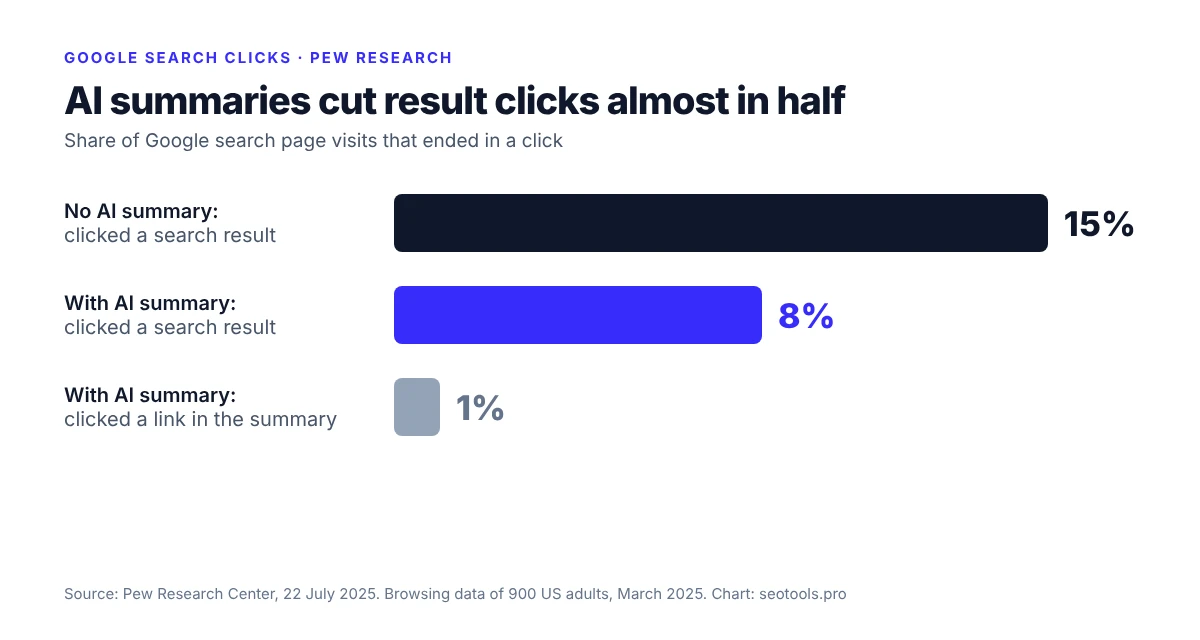
With an AI summary, people clicked a traditional result in 8% of visits, vs 15% without one. They clicked a link inside the summary in just 1% of visits.
Google's own view is that clicks from AI Overview pages are "higher quality", with visitors more likely to spend more time on the site.
Both can be true. That's why a GEO service should report AI visibility and the leads it brings, not just traffic.
What You're Actually Buying
Here's how we split SEO, real GEO add-ons and the work Google says you can skip.
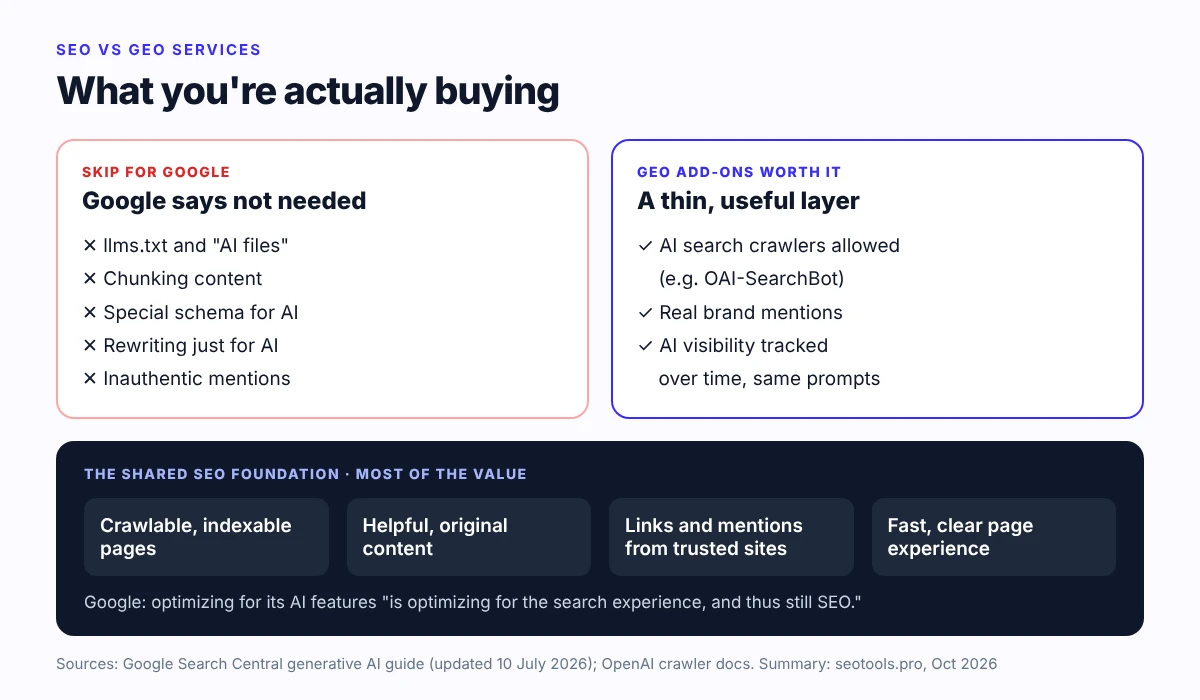
Most of the value sits in the foundation. GEO adds a thin, useful layer on top: access, real mentions and measurement.
Our Own Check: Which AI Cites seotools.pro?
We ran our free AI Visibility Checker on our own domain on 30 October 2026. It reads AI answers recorded in October 2026 for the United States.
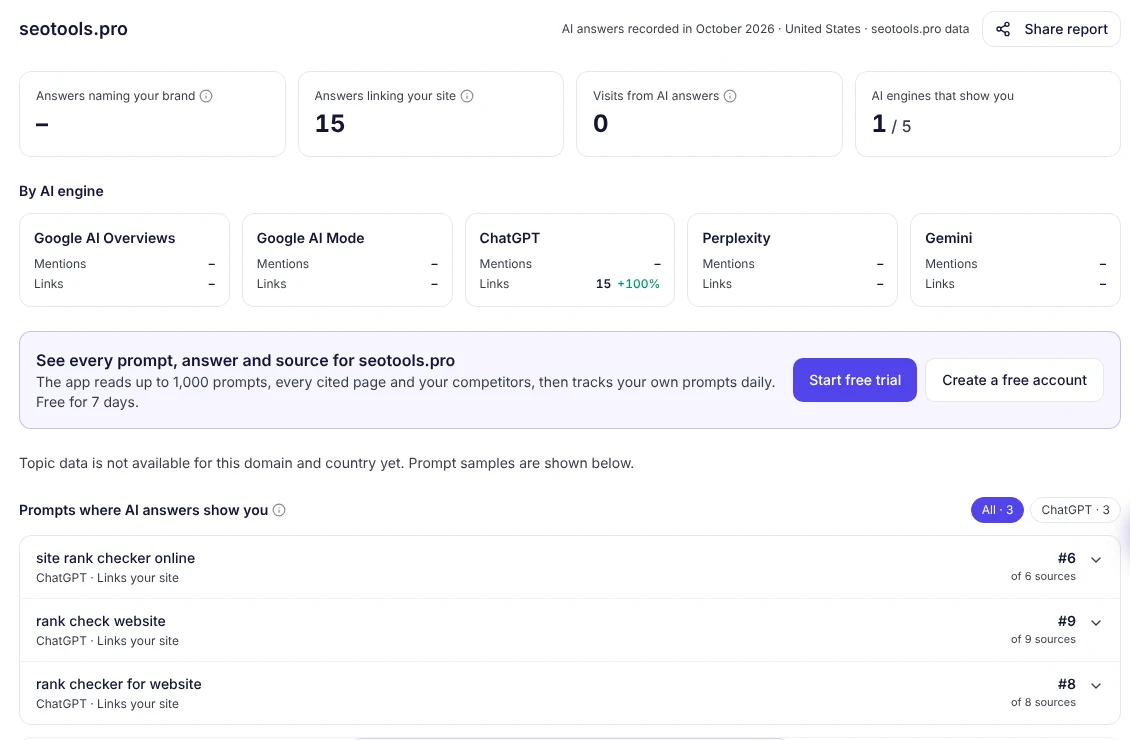
The result is humbling, and useful:
- 15 AI answers linked to our site, all of them in ChatGPT.
- The other 4 engines (AI Overviews, AI Mode, Perplexity and Gemini) showed no mentions or links.
- No answers named our brand in the text. They only linked one of our pages as a source.
- The prompts were classic search phrases, like "rank check website".
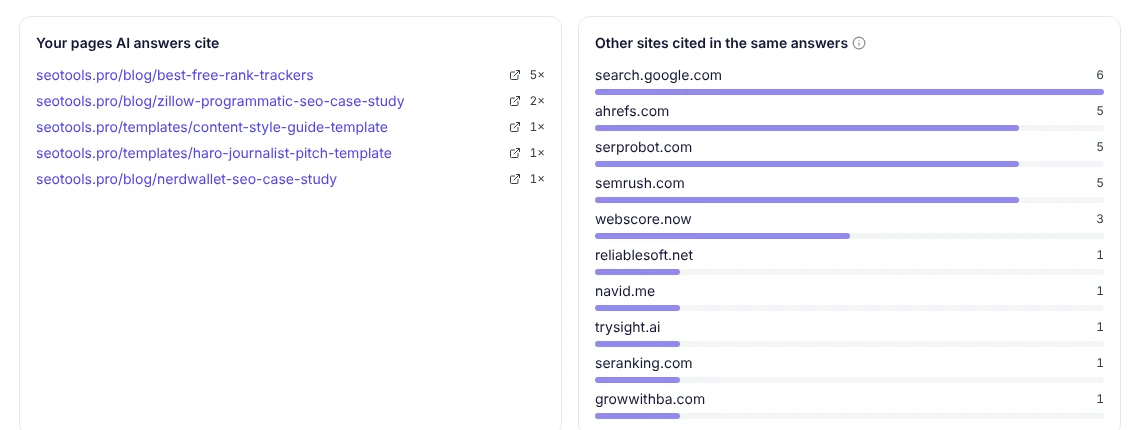
Look at what got cited most: our guide to the best free rank trackers, 5 times in the sampled answers. It's a classic SEO article, built for Google search.
We can't see exactly why an AI picks a page. But here, the most-cited page is a regular guide that answers the question well.
The gap is just as clear. We're invisible in 4 of 5 engines. That's the part a GEO service should measure and work on, not "fix" with a new file.
What People Search For
We checked the buyer language in our free Keyword Research tool on 30 October 2026 (United States):
- "generative engine optimization": about 3,600 searches a month, difficulty 78, about $11.78 a click.
- "geo vs seo": about 1,300 searches a month, difficulty 71.
- "generative engine optimization agency": about 390 searches a month, about $23.74 a click.
- "geo services": about 320 a month, but its related searches are mostly about companies with "GEO" in their name, like credential, security and petroleum services.
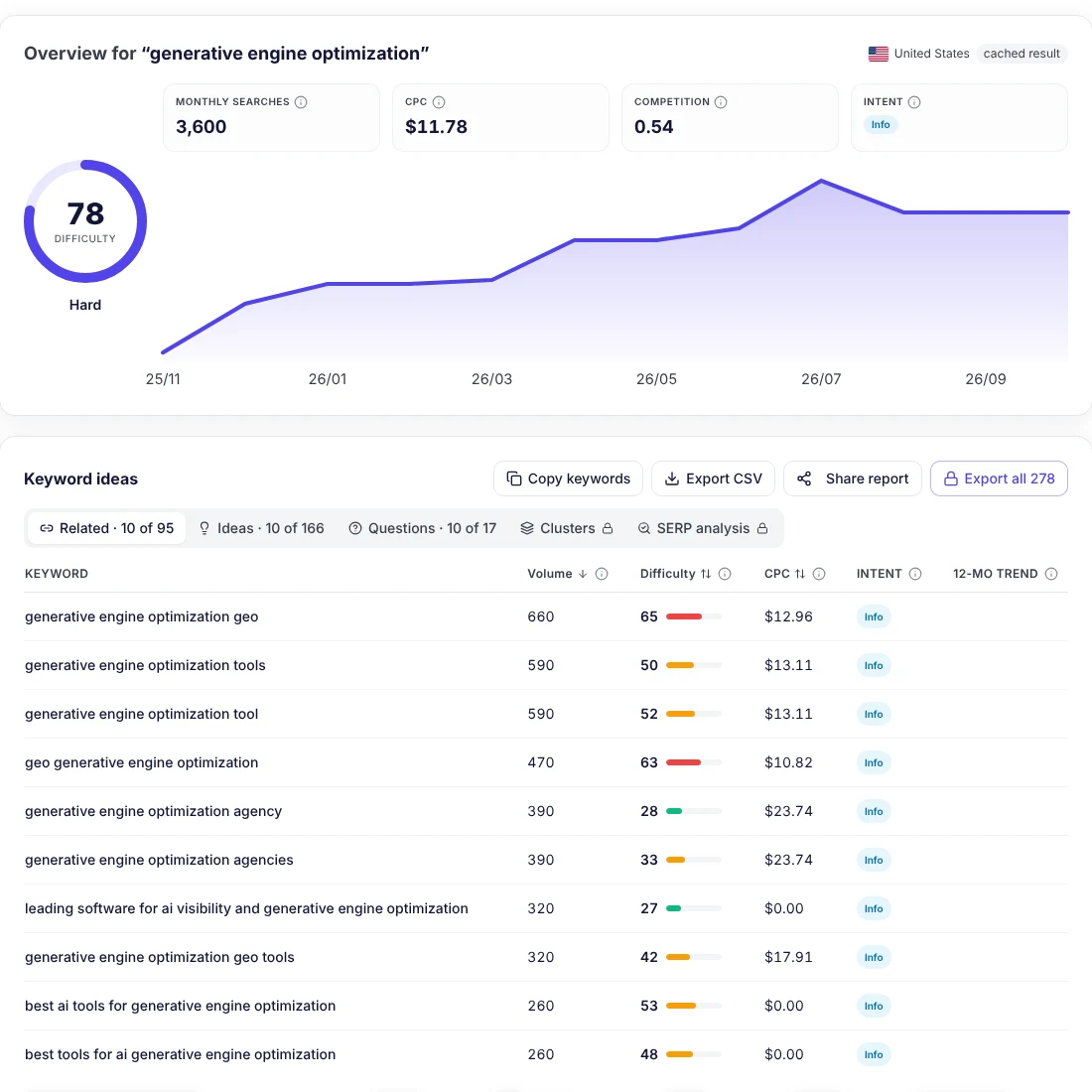
Two takeaways. The spelled-out term "generative engine optimization" gets the most searches, while "GEO" alone is ambiguous. And advertisers pay about twice as much per click for the agency term ($23.74) as for the topic ($11.78).
Interest is real. That's also why hype is everywhere.
Which One Do You Need?
SEO first, if:
- Your pages aren't indexed, rank below page 1 or get few clicks.
- Your site is new, slow or recently redesigned.
- You don't have pages that answer your buyers' main questions yet.
SEO with a GEO layer, if:
- You already rank, but AI answers name competitors instead of you.
- Your buyers research in ChatGPT or Perplexity before they buy.
- You need to report AI visibility to a boss or client.
A standalone GEO service, rarely. If the SEO basics are weak, GEO has little to stand on. Google's guide says its AI features rely on its core ranking and spam systems.
Still deciding between tools and people? Read SEO software vs SEO services.
Red Flags When Buying GEO Services
- Guaranteed AI citations or "#1 in ChatGPT". No one controls what AI answers show.
- "Internal" Google data. Google says "No third-party tool has access to our internal ranking or AI systems."
- llms.txt as the main deliverable. Google Search ignores it. Fine to add, not worth a retainer.
- Rewriting every page "for AI". Google says you don't need to.
- Paid or fake mentions. Google warns inauthentic mentions aren't as helpful as they seem, and spam systems apply.
- Reports made of screenshots. You need the same prompts tracked over time, with dates and engines.
Six Questions to Ask Any Provider
- What exactly is included, and what isn't? Get it in writing.
- Which prompts and AI engines will you track, and how often?
- How do you measure success: mentions, citations, AI impressions or leads?
- Who implements the fixes: you, my developer or your team?
- Where will mentions or links come from? Can I see examples first?
- What do I own, and what happens if I stop?
Check Your Own GEO Baseline for Free
Before you pay anyone, spend 20 minutes on these:
- Run our free AI Visibility Checker. See which of 5 AI engines name or link your site, and for which prompts. 3 free checks a day, no account.
- Open Search Console's Generative AI reports. Google rolled them out to all sites by 31 August 2026. They show AI feature impressions by page, country and date.
- Check Bing Webmaster Tools' AI Performance. It shows citations and the "grounding queries" behind them.
- Check robots.txt. Make sure you're not blocking Googlebot, Bingbot or OAI-SearchBot by mistake.
- Run a free Website Audit. It catches crawl and indexing issues that hurt both SEO and GEO.
- Check your rankings for your main keywords with our Rank Tracker. AI answers often cite pages that already rank.
Want to track your own prompts every day? The AI Visibility Tracker is on paid plans, with a 7-day free trial.
When You Need Help
We sell both, so here's our bias in the open. Our SEO and GEO services are one project, not two retainers.
Every package includes an SEO audit, keyword research, a content plan and a before-and-after AI visibility report. We don't guarantee rankings or citations.
Pricing depends on your site and market. Book a free consultation with Anatolii Ulitovskyi to see where you stand in search and in AI answers.
Check your site across 5 AI engines and see the real prompts and answers behind the numbers.
- Google AI Overviews, AI Mode, ChatGPT, Perplexity, Gemini
- Mentions and citations counted separately
- 3 free checks a day, no account
- Works on competitors' domains too
The Verdict
SEO gets your pages ranked. GEO is about getting your brand into the answer. For Google, they're the same work.
Pay for SEO first. Add GEO when you already rank and want to know, and grow, how AI assistants talk about you.
The best GEO service is good SEO plus honest measurement. Anything sold as a secret AI trick deserves a hard second look.
FAQ
What is the difference between SEO and GEO?
SEO helps your pages rank and get clicks in search results. GEO (generative engine optimization) aims to get your brand mentioned and cited in AI answers. Both rest on the same foundation.
Does Google need special GEO work?
Google says no. Its 2026 guide calls optimizing for its generative AI features "still SEO" and says llms.txt files, chunking and special schema aren't required.
Is GEO the same for ChatGPT and Perplexity?
Not exactly. Each assistant has its own crawler and sources. For example, OpenAI says sites that block OAI-SearchBot won't be shown in ChatGPT search answers. Good SEO still does most of the work.
How do I measure GEO results?
Track the same prompts over time in an AI visibility tool, and use Search Console's Generative AI reports and Bing's AI Performance report. Then connect that visibility to leads and sales.
Can anyone guarantee AI citations?
No. AI answers change often, and no provider controls them. A good provider guarantees the scope of work and transparent reporting, not citations.
Sources
Google on GEO: Google Search Central, "Google's Guide to Optimizing for Generative AI Features on Google Search" (last updated 10 July 2026).
Google on AI clicks: "Top ways to ensure your content performs well in Google's AI experiences on Search" (21 May 2025).
AI reports: Google, "Introducing Search Generative AI performance reports in Search Console" (3 June 2026); Bing, "Introducing AI Performance in Bing Webmaster Tools Public Preview" (10 February 2026).
Crawlers: OpenAI, "Overview of OpenAI Crawlers", checked 30 October 2026.
Clicks: Pew Research Center, 22 July 2025. GEO paper: Aggarwal et al., "GEO: Generative Engine Optimization" (arXiv, 2023).
Danny Sullivan quote: Search Engine Land. AI visibility and keyword data (including CPC): seotools.pro, 30 October 2026.